
“Tolkien, Technology, and Magic” with Brad Birzer (Video)
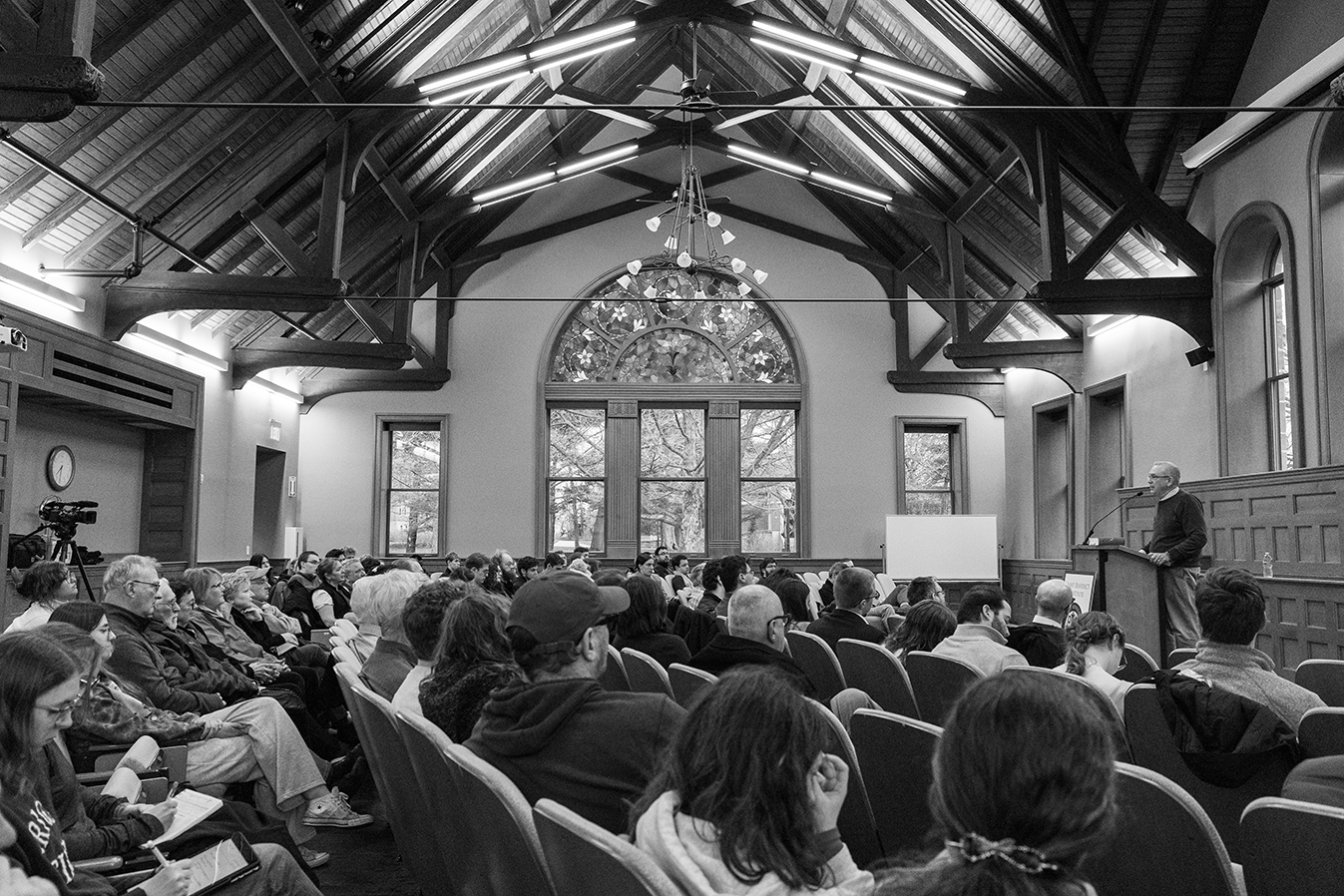
Dr. Bradley Birzer addresses attendees in Winants Auditorium. Photo by Adam Vander Kooy.
by Tacy Kratt ‘27
On March 11, the Saint Benedict Institute hosted Dr. Bradley Birzer, an author and professor of history at Hillsdale College, for an engaging public talk entitled “Tolkien, Technology, and Magic.” In it, Dr. Birzer explained how J.R.R Tolkien’s views of modernity, war, and humanity surfaced in The Lord of the Rings, the epic trilogy that has earned Tolkien recognition as “the greatest mythmaker of our day and of modernity.” However, Dr. Birzer argued that Tolkien’s legacy extends beyond literary excellence. Tolkien’s insights on what it means to be human and how to live a good life in the face of evil remain strikingly relevant today.
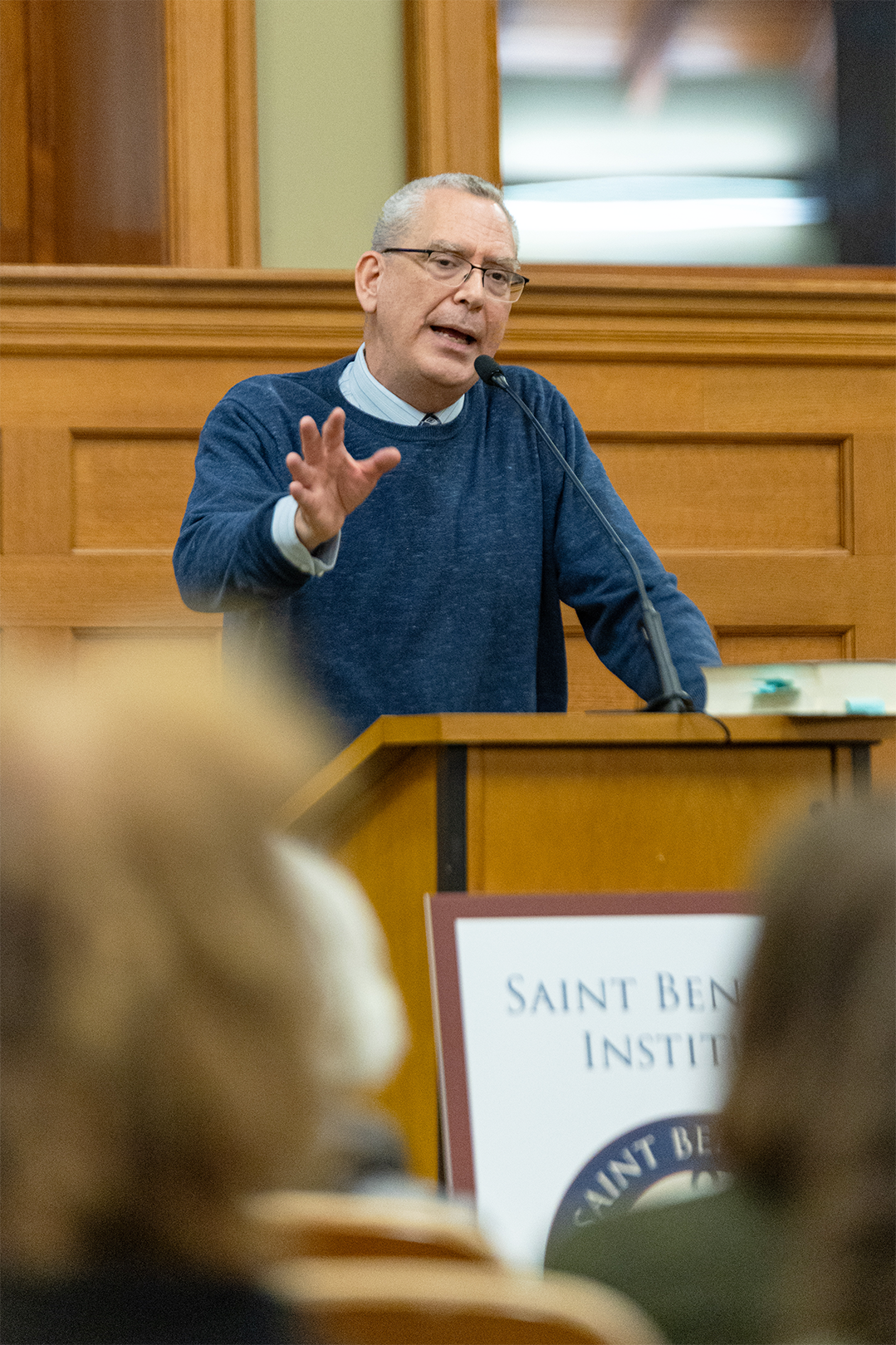
Dr. Brad Birzer. Photo by Adam Vander Kooy.
Dr. Birzer began the lecture by reading an excerpt from The Two Towers in which Frodo, Sam, and Gollum cross “no man’s land,” a term also used during World War I to refer to the land between enemy trenches. According to Dr. Birzer, this fictional scene provides insight into Tolkien’s real wartime experiences, which deeply affected his writing and worldview. Tolkien describes the place as “a land defiled,” a phrase evoking Tolkien’s own world, defiled by systematic killing at a scale never before seen.
Dr. Birzer examined the staggering death toll of the twentieth century, identifying the rise of technology and ideology as two factors unique to this time period. “Technology can be so good,” he said, mentioning modern-day surgery techniques that save lives and cars that make driving from Hillsdale to Hope possible and safe. “But technology also makes atomic weapons possible.” Unsurprisingly, the potential for technology to be used for good or evil emerges as a theme in Tolkien’s writings.
Dr. Birzer also argued that ideology is a unique modern-day phenomenon, tracing the beginning of ideology as we know it to the French Revolution. He quoted C.S. Lewis’s observation that ideology is “truth exploded to madness” and referenced twentieth-century giants like Darwin, Marx, and Freud, who were “brilliant but so simplistic” in their interpretation of the world and of people as solely biological, economical, or psychological.
Tolkien’s writing can be understood, in part, as a reaction to these various fragmented ideologies. Rather than distorting truth or unmaking the world in the way that Nazism, communism, and other ideologies did in the twentieth century, Tolkien wanted not to undo creation but to “make it greater”. Tolkien’s Catholic faith informed his belief that “we need to put our hope in the next world…but it’s our duty to bring beauty to the world in the state we’re in”. Dr. Birzer mentioned Tolkien’s theory of subcreation: the idea that human beings are called to create artistically in imitation of God, who created each person as utterly individual, with unique gifts. “This is the lesson of The Lord of the Rings,” he said. “To use our gifts, no matter how small, to beautify the world. Does it get us to Heaven? Of course not. But God smiles on us.”
The night concluded with a thought-provoking question-and-answer session between students and Dr. Birzer. Junior Brigit Foley, a member of Hope Catholics who attended the event because she’s a fan of Tolkien’s writing, stated “The ending really struck me—no matter how small the thing is that you do, any small gift that’s used to beautify the world makes the world better. It doesn’t save the world or your soul, but it makes God smile. So it made me think, how do I live that out?”
Bradley J. Birzer is Russell Amos Kirk Chair of American Studies and Professor of History, Hillsdale College, where he has taught for twenty-seven years. He is the author of several books, including J. R. R. Tolkien’s Sanctifying Myth and Tolkien and the Inklings: Men of the West. He and his wife (also an academic) have seven kids, one dog, and five cats.
“Tolkien, Technology, and Magic” was supported by a grant from the Lumen Christi Institute with funding from the John Templeton Foundation and was co-sponsored by Hope College Cultural Affairs Committee, Markets and Morality, the English Department, andthe Religion Department.
