Catholic-Reformed Dialogue Rhonda Ortiz Catholic-Reformed Dialogue Rhonda Ortiz

(VIDEO) The Catholic Priesthood: Why Is It Reserved to Men? Catholic-Reformed Dialogue with Sr. Sara Butler and Dr. Jim Brownson

“THE CATHOLIC PRIESTHOOD: WHY IS IT RESERVED TO MEN?”

Talk and Catholic-Reformed Dialogue
with Sr. Sara Butler and Dr. Jim Brownson

The Catholic Church “has no authority to confer priestly ordination on women.” Such was the solemn declaration of Pope St. John Paul II and the beginning of the argument Sister Sara Butler made at Hope College in a lecture on Thursday, January 26, 2017 at 7 p.m. in Winants Auditorium in Graves Hall at Hope College. Sr. Sara Butler argued that the unbroken tradition of the Catholic Church is not discrimination against women but related to the doctrine of Holy Orders as a sacrament.  Dr. Jim Brownson of Western Theological Seminary provided a response.

Sister Sara Butler, M.S.B.T., Ph.D., S.T.L. is Professor Emeritus of Dogmatic Theology at the University of St. Mary of the Lake, Mundelein, IL.  Sister Sara has served on the Anglican-Roman Catholic International Commission and the International Theological Commission (a papal appointment).  She is past president of the Academy of Catholic Theology and is currently a consultant to the U.S. Catholic Bishops’ Doctrine Committee.  She is the author of many scholarly articles and of The Catholic Priesthood: A Guide to the Teaching of the Church (Hillenbrand Books, 2007).

Dr. Jim Brownson is the James and Jean Cook Professor of New Testament at Western Theological Seminary (Holland, MI), where he teaches courses on Scripture, church governance, and women's ordination. He’s the author of several books, including most recently Bible, Gender, Sexuality: Reframing the Church’s Debate on Same-Sex Relationships (Eerdmans, 2013). 

The event was co-sponsored by Western Seminary and the Departments of Religion and Women's and Gender Studies at Hope College.

On January 26, 2017, Sr. Sara Butler spoke on "The Catholic Priesthood: Why Is It Reserved to Men?" Dr. Jim Brownson responded. This event was part of the Saint Benedict Institute Catholic-Reformed Dialogue series.
Read More
News Jared Ortiz News Jared Ortiz

Calendar of Events 2015-2016

Dawn Eden on Chastity, Duncan Stroik on Architecture for the Poor, Anthony Esolen on the Liberal Arts, Spiritual Friendship authors on being gay and Christian, Sr. Miriam James Heidland on hope...check out our upcoming events.
professors pondering

Dawn Eden on Chastity, Duncan Stroik on Architecture for the Poor, Anthony Esolen on the Liberal Arts, Spiritual Friendship authors on being gay and Christian, Sr. Miriam James Heidland on hope....check out our Calendar of Events 2015-16.

Read More
Catholic-Reformed Dialogue, News Jared Ortiz Catholic-Reformed Dialogue, News Jared Ortiz

A Catholic Bishop Comes to Hope College

VIDEO AVAILABLE: His Excellency David Walkowiak, Bishop of the Diocese of Grand Rapids, visited Hope College on Wednesday, February 4, 2015, for an informal question and answer session.
By Anna Jones, Theater Major, Hope College '18

It was Wednesday, February 4, and faculty, students, and members of the surrounding community were gathering in Winants Auditorium in Hope College’s Graves Hall. Some came with questions, others with pencils or laptops at the ready, but all with welcoming hearts. Bishop David Walkowiak of Grand Rapids was invited to speak at Hope College by the Saint Benedict Forum. The event was co-sponsored by Hope’s Campus Ministries, Religion Department, and Office of the Provost. This was to be the first time in Hope College’s 149-year history that a Roman Catholic Bishop would make an official visit to the college. As a Catholic student at Hope, I was incredibly excited to be a part of this historic event.

After a brief introduction by the Chair of Hope’s Religion Department, Dr. Jeff Tyler, Bishop David Walkowiak of Grand Rapids took the podium. The bishop spoke for about twenty minutes regarding his vision for the Diocese of Grand Rapids, an office that he has held for just under two years. Bishop Walkowiak was appointed by Pope Francis to serve the eleven counties and over 191,000 Catholics that constitute the Grand Rapids Diocese.

An extensive question and answer session followed Bishop Walkowiak’s opening statements. There were a wide variety of questions asked from the diverse spectrum of attendees. The questions ranged from liturgical to political, covering issues from Eucharistic protocol to reaching out to the Latino community. While these topics were both intriguing and informative, what hit home most for me was Bishop Walkowiak’s effort to “have the scent of his flock,” as Pope Francis exhorts.

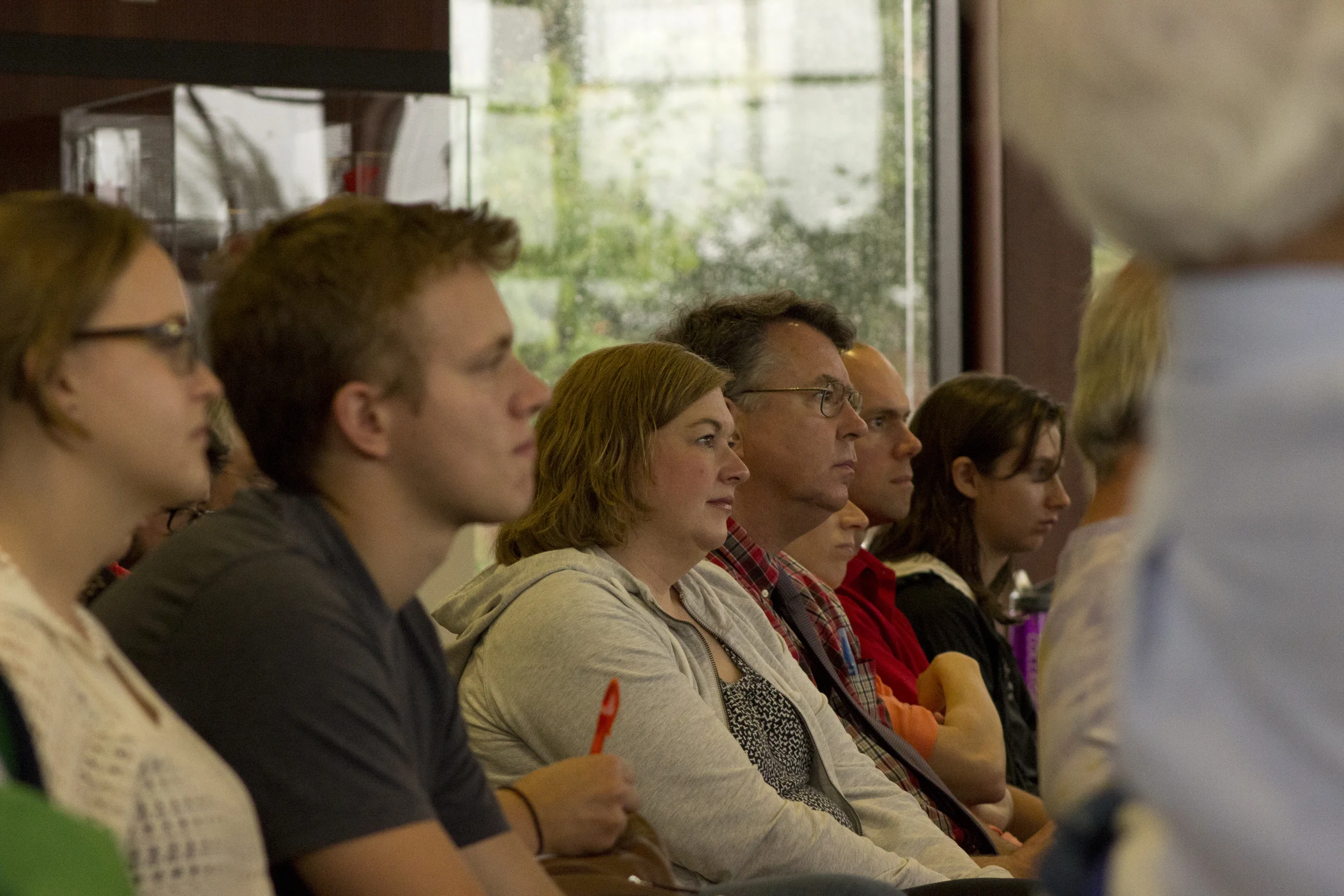
profs and community pondering

profs and community pondering

About one third of the population of the Diocese of Grand Rapids is Latino. In an effort to better serve this segment of his flock, Bishop Walkowiak learned to speak Spanish. This ability enables him to personally extend the sacrament of Confirmation and celebrate Mass for the Spanish speaking part of his community. Bishop Walkowiak’s commitment to being personally present to his people shows just how dedicated he is to the service of his office.

Bishop Walkowiak’s devoted service can be seen to spring from a deep knowledge about the Christian life. He shared his knowledge in response to a question concerning the nature of love in the Christian vocation. Bishop Walkowiak expounded upon the idea of agape, that highest love of disinterested self-sacrifice. The bishop commented that agape is “outward bound,” it is the unconditional giving of oneself.

With his unique mixture of quiet dignity and authentic congeniality, there couldn’t have been anyone more suited to present to Hope College an example of what ecclesial service should look like. Bishop Walkowiak demonstrated to our Protestant brothers and sisters the unity that the Church desires, and in turn, Hope College recognized and reciprocated that ecumenical desire.

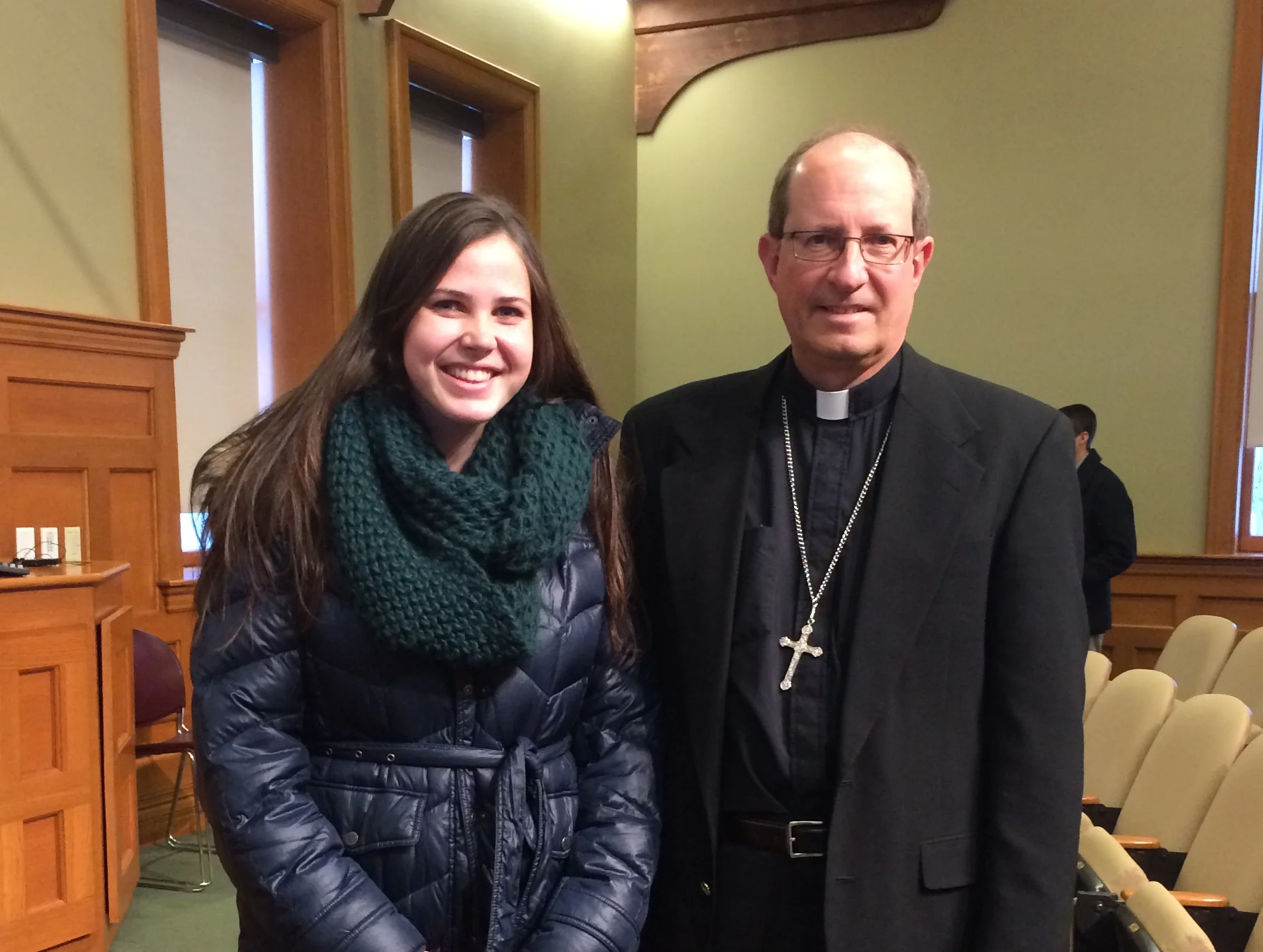
Rebecca and Bishop

Rebecca and Bishop

After the conversation in Winants, Bishop Walkowiak, along with members and supporters of the Saint Benedict Forum, enjoyed Christian fellowship and dinner in Hope College’s Maas Conference room. After the dinner, following a long established tradition for speakers who visit Hope, Bishop Walkowiak shared a personal testimony with those present. Bishop Walkowiak’s story wasn’t one of a dramatic conversion or wrought with great life-changing events. It was the story of an ordinary boy who grew up in a good Catholic home. It was the story of a young man who heard God’s call and had the courage to trust and follow. One of the most poignant moments of Bishop Walkowiak’s testimony was when he described how his mother taught him a vocation prayer to pray each day.

“O God, Who enlightens the minds and inflames the hearts of the faithful by the Holy Spirit, grant that by the same Spirit I may know my true vocation in life and have the grace to follow it faithfully. Through Christ our Lord. Amen.”

Its simple sweetness became a part of Bishop Walkowiak’s routine as he discerned his call to the priesthood. Bishop Walkowiak’s visit to Hope College was yet a further step towards achieving the Christian unity to which Christ calls us.

The video of Bishop Walkowiak's talk and Q & A session is available here.

Read More
Catholic Speaker Series, News Jared Ortiz Catholic Speaker Series, News Jared Ortiz

Brad Gregory Discusses the Unintended Consequences of the Reformation

"Mind-blowing." That is how one student described Brad Gregory's talk on "The Reformation Era and the Making of Modernity," delivered last Wednesday, October 15, 2015, as part of Grand Rapids Notre Dame Alumni Club Hesburgh Lecture, and co-sponsored by Aquinas College's Catholic Studies Program and the Saint Benedict Forum.

"Mind-blowing."  That is how one student described Brad Gregory's talk, "The Reformation Era and the Making of Modernity," delivered last Wednesday, October 15, 2015, as part of Grand Rapids Notre Dame Alumni Club Hesburgh Lecture, and co-sponsored by Aquinas College's Catholic Studies Program and the Saint Benedict Forum.

BradGregoryGregory began his talk by asking, "How did the world we live in today come to be as it is?"  The West today, he argued, is characterized by pervasive all-encompassing institutions and market capitalism as well as a bewildering plurality of conflicting open-ended truth claims.  How did we get this way?  Most accounts begin with the the Enlightenment, the scientific and industrial revolutions, the American and French Revolutions, but Gregory argued that these, while important, must be understood in light of the 16th century doctrinal conflicts of the Reformation.  And to understand the Reformation and its consequences, we need to understand the medieval world in which it occurred.

The medieval world was complicated and multi-layered, but one peculiar dimension of it is most notable: religion permeated every aspect of human reality.  The Catholic Church was the recognized authority which governed the claims of that religion, so when the Reformation rejected the Catholic Church it was bound to affect all aspects of life which had been informed by those truth claims.  This rejection and the rival claims to Christian truth had unintended--and undesirable--consequences for the future.  With sensitivity and scholarly rigor, Gregory traced these unintended consequences from the rallying cries of the Reformers--"Here I stand" and sola Scriptura--to our contemporary situation.  He claimed that the Reformers would be horrified by many aspects of our modern world, but they unwittingly set the stage for it.

Brad Gregory is Dorothy G. Griffin Professor of Early Modern European History at Notre Dame University.  His talk was based on his recent book, The Unintended Reformation: How a Religious Revolution Secularized Society.

Read More