Interview with Catholic World Report
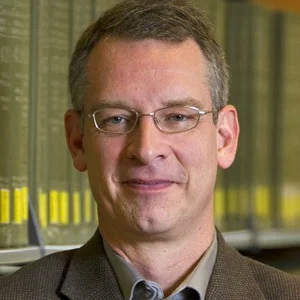
Co-founders Jared Ortiz and Jack Mulder were recently interviewed by Carl Olson of Catholic World Report. They spoke about the founding of the Saint Benedict Forum, their vision, and their plans for the future. You can read the full interview here.
A Catholic Bishop Comes to Hope College
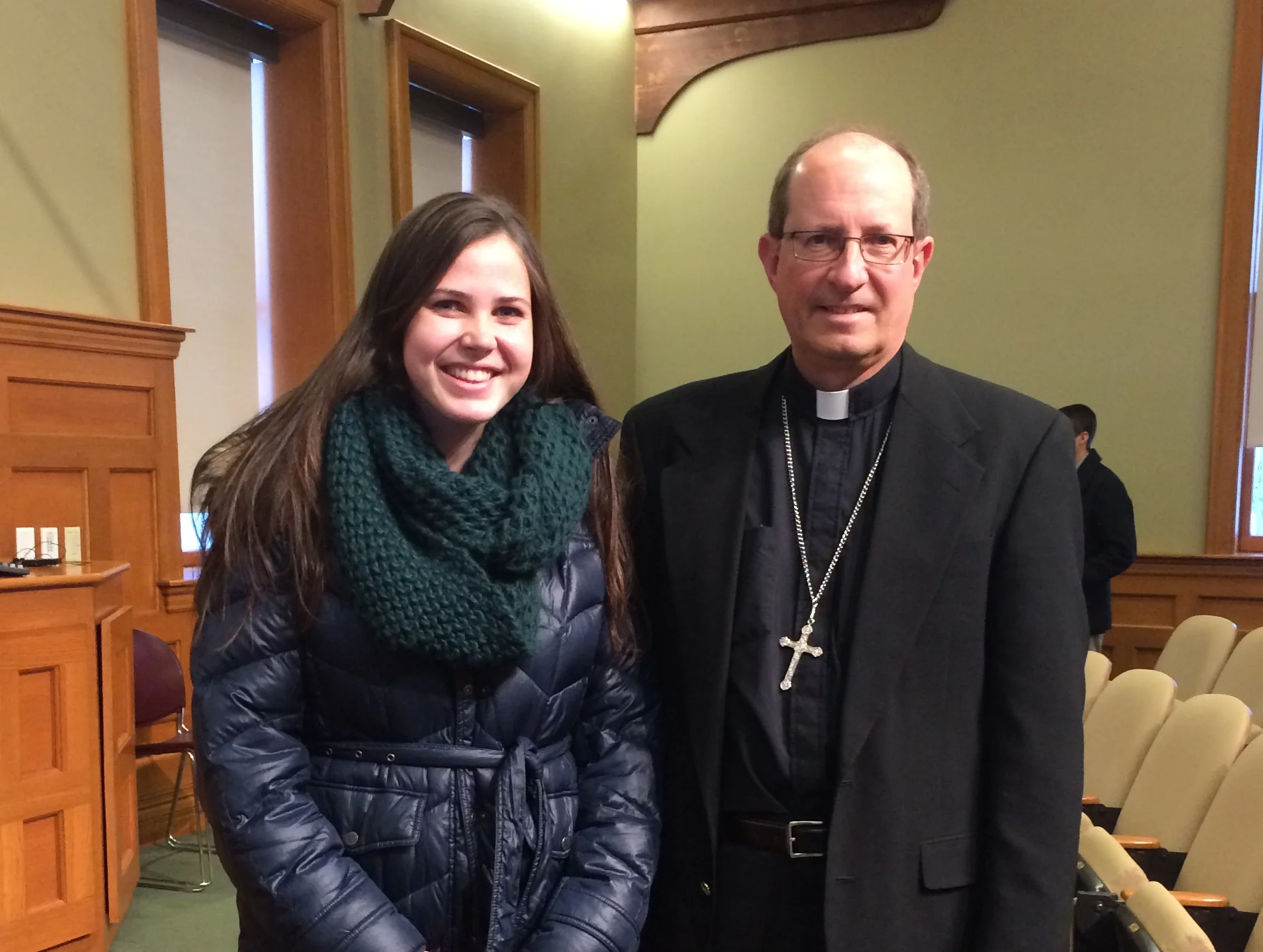
VIDEO AVAILABLE: His Excellency David Walkowiak, Bishop of the Diocese of Grand Rapids, visited Hope College on Wednesday, February 4, 2015, for an informal question and answer session.
By Anna Jones, Theater Major, Hope College '18
It was Wednesday, February 4, and faculty, students, and members of the surrounding community were gathering in Winants Auditorium in Hope College’s Graves Hall. Some came with questions, others with pencils or laptops at the ready, but all with welcoming hearts. Bishop David Walkowiak of Grand Rapids was invited to speak at Hope College by the Saint Benedict Forum. The event was co-sponsored by Hope’s Campus Ministries, Religion Department, and Office of the Provost. This was to be the first time in Hope College’s 149-year history that a Roman Catholic Bishop would make an official visit to the college. As a Catholic student at Hope, I was incredibly excited to be a part of this historic event.
After a brief introduction by the Chair of Hope’s Religion Department, Dr. Jeff Tyler, Bishop David Walkowiak of Grand Rapids took the podium. The bishop spoke for about twenty minutes regarding his vision for the Diocese of Grand Rapids, an office that he has held for just under two years. Bishop Walkowiak was appointed by Pope Francis to serve the eleven counties and over 191,000 Catholics that constitute the Grand Rapids Diocese.
An extensive question and answer session followed Bishop Walkowiak’s opening statements. There were a wide variety of questions asked from the diverse spectrum of attendees. The questions ranged from liturgical to political, covering issues from Eucharistic protocol to reaching out to the Latino community. While these topics were both intriguing and informative, what hit home most for me was Bishop Walkowiak’s effort to “have the scent of his flock,” as Pope Francis exhorts.
About one third of the population of the Diocese of Grand Rapids is Latino. In an effort to better serve this segment of his flock, Bishop Walkowiak learned to speak Spanish. This ability enables him to personally extend the sacrament of Confirmation and celebrate Mass for the Spanish speaking part of his community. Bishop Walkowiak’s commitment to being personally present to his people shows just how dedicated he is to the service of his office.
Bishop Walkowiak’s devoted service can be seen to spring from a deep knowledge about the Christian life. He shared his knowledge in response to a question concerning the nature of love in the Christian vocation. Bishop Walkowiak expounded upon the idea of agape, that highest love of disinterested self-sacrifice. The bishop commented that agape is “outward bound,” it is the unconditional giving of oneself.
With his unique mixture of quiet dignity and authentic congeniality, there couldn’t have been anyone more suited to present to Hope College an example of what ecclesial service should look like. Bishop Walkowiak demonstrated to our Protestant brothers and sisters the unity that the Church desires, and in turn, Hope College recognized and reciprocated that ecumenical desire.
After the conversation in Winants, Bishop Walkowiak, along with members and supporters of the Saint Benedict Forum, enjoyed Christian fellowship and dinner in Hope College’s Maas Conference room. After the dinner, following a long established tradition for speakers who visit Hope, Bishop Walkowiak shared a personal testimony with those present. Bishop Walkowiak’s story wasn’t one of a dramatic conversion or wrought with great life-changing events. It was the story of an ordinary boy who grew up in a good Catholic home. It was the story of a young man who heard God’s call and had the courage to trust and follow. One of the most poignant moments of Bishop Walkowiak’s testimony was when he described how his mother taught him a vocation prayer to pray each day.
“O God, Who enlightens the minds and inflames the hearts of the faithful by the Holy Spirit, grant that by the same Spirit I may know my true vocation in life and have the grace to follow it faithfully. Through Christ our Lord. Amen.”
Its simple sweetness became a part of Bishop Walkowiak’s routine as he discerned his call to the priesthood. Bishop Walkowiak’s visit to Hope College was yet a further step towards achieving the Christian unity to which Christ calls us.
The video of Bishop Walkowiak's talk and Q & A session is available here.
March for Life: Becoming Missionary Disciples
Every year on the anniversary of the Roe v. Wade decision, hundreds of thousands of people come to Washington, D.C. to peacefully protest against abortion and to bear witness to the dignity of every human life. The Saint Benedict Forum is proud to be bringing its first group of students to the March this year.
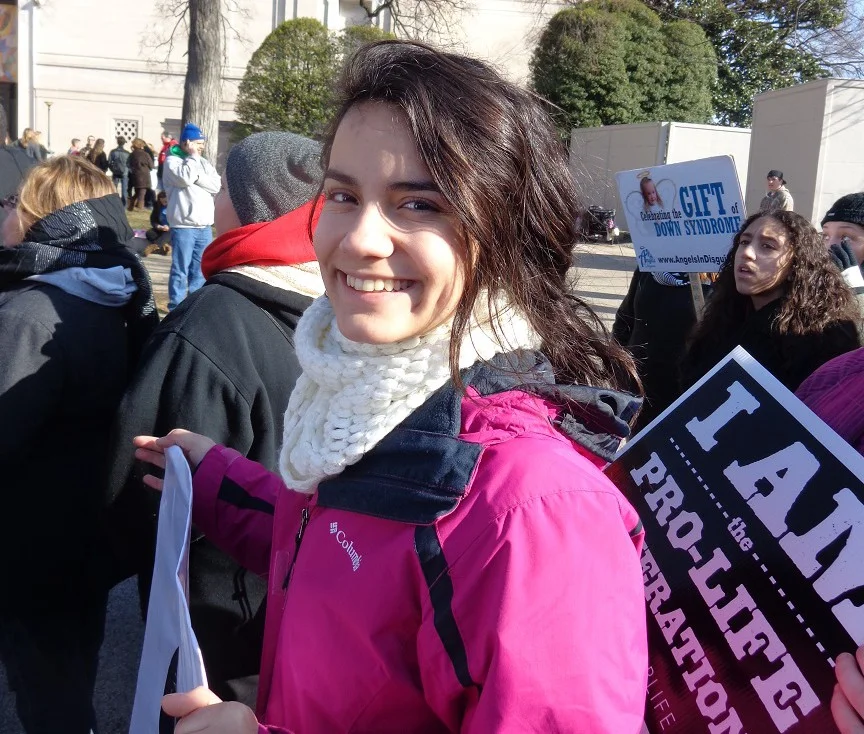
Marchers have been gathering in Washington D.C. since 1974 on January 22nd to protest the Supreme Court’s landmark Roe v. Wade decision legalizing abortion in the USA. While this was the 41st annual “March for Life,” joining the event for possibly the first time were students from Hope College. The Saint Benedict Forum sponsored the Hope College contingent.
The group departed from Holland around 3:30pm the day before the march, arriving at their destination safe, but tired around 2am Thursday morning. After a short night’s sleep the team was up and off to its first event, the “Life is Very Good” rally sponsored by the Diocese of Arlington, VA and held at the Patriot Center on the campus of George Mason University. Any sleepiness was soon dispelled by the inspirational message of Catholic Apologist Chris Stefanick, the music of Ike Ndolo Band, and the rousing homily brought by Bishop Loverde of the host diocese. Besides the thousands of young people in attendance, it was a powerful experience to see all the priests, seminarians and women religious present.
“There were around 100 or more priests that attended as well as four bishops” commented Eric Plaehn. “ I thought their dedication to the event, to the sacrament of the Eucharist and also to inspiring young minds (the next great generation) was very powerful."
After the rally the group motored up to Washington D.C. to join the actual march. The group merged with the main body of marchers on Constitution Ave. about 5 blocks from the actual starting point. Hundreds of thousands of marchers passed famous sites such as the National Gallery of Art and the US Capitol with their peaceful but forthright pro-life message. The march ended appropriately enough in front of the Supreme Court building.
“It was eye-opening and moving to see so many people, who were mainly young adults, come together from across the globe to be the voice for the voiceless” said fellow marcher Kelley McKeon.
“I spent the majority of the March silent, just taking in everything that was happening around me.” According to Madeline Taylor, what was most impressive was the respect shown by all involved.
“To my knowledge, there was no belligerence; just the prayerful and respectful articulation of a deeply held belief. Indeed, there was a beautiful element of joy involved, as everyone present seemed to be happy to have the opportunity to speak up for our society's most vulnerable members” she said.
Following the March, the group walked down to the Holocaust Museum and learned of the atrocities committed against humanity by Nazi Germany during World War II. It was a good closing activity for a day focused on life and human dignity. It is clear that Catholics have much to do in our nation. Eric’s sentiment mirrored what the whole group was thinking at the end of the day.
“My mission is to take on the roles of a missionary disciple lovingly condemning evil, counseling and consoling the afflicted and to standing for my brothers and sisters, especially those that can’t stand for themselves.”
"Mary is a Christian Thing": Director Jared Ortiz Speaks on Mary to Protestant Students
On December 15, Dr. Jared Ortiz spoke to 800 students at Holland Christian High School about the meaning of Mary and how she can help us prepare to receive Christ at Christmas. Watch the video.
On December 15, Dr. Jared Ortiz spoke to 800 students at Holland Christian High School about the meaning of Mary and how she can help us prepare to receive Christ at Christmas. Ortiz's talk begins around 4:55.
Advent Retreat: Preparing for Christ
Advent is a time to prepare ourselves for the coming of Christ. On Saturday, December 6, the Saint Benedict Forum hosted a retreat to help all of us get ready for Christmas. Students and parishioners enjoyed an abundant breakfast spread before listening to a beautiful talk by Dr. Jack Mulder on the meaning of waiting, suffering, and adoption. Dr. Jared Ortiz also offered a reflection on what Advent and Christmas might look like through the eyes of Mary. After each talk, students and parishioners shared personal thoughts and experiences on the themes of the talks.
There was a holy hour before the Blessed Sacrament during which two priests were available for confession. The retreat ended with Mass.
Two Talks on Prayer
Three times a week, one thousand Hope College students gather to praise God and listen to a meditation on Scripture. Recently, co-founders, Dr. Jared Ortiz and Dr. Jack Mulder, were invited to speak on prayer.
Dr. Ortiz spoke on "The Meaning of Prayer," October 24, 2014.
Dr. Mulder spoke on "The Name of Jesus," October 29, 2014.
Director Jared Ortiz Featured in FAITH Magazine
FAITH Magazine recently ran an article on Jared Ortiz, Director and Co-founder of the Saint Benedict Forum. The article discusses the gory details of Ortiz's conversion story as well as how the Saint Benedict Forum came into being. Well worth a read, though not for the faint of heart. Read the whole story here.
Brad Gregory Discusses the Unintended Consequences of the Reformation
"Mind-blowing." That is how one student described Brad Gregory's talk on "The Reformation Era and the Making of Modernity," delivered last Wednesday, October 15, 2015, as part of Grand Rapids Notre Dame Alumni Club Hesburgh Lecture, and co-sponsored by Aquinas College's Catholic Studies Program and the Saint Benedict Forum.
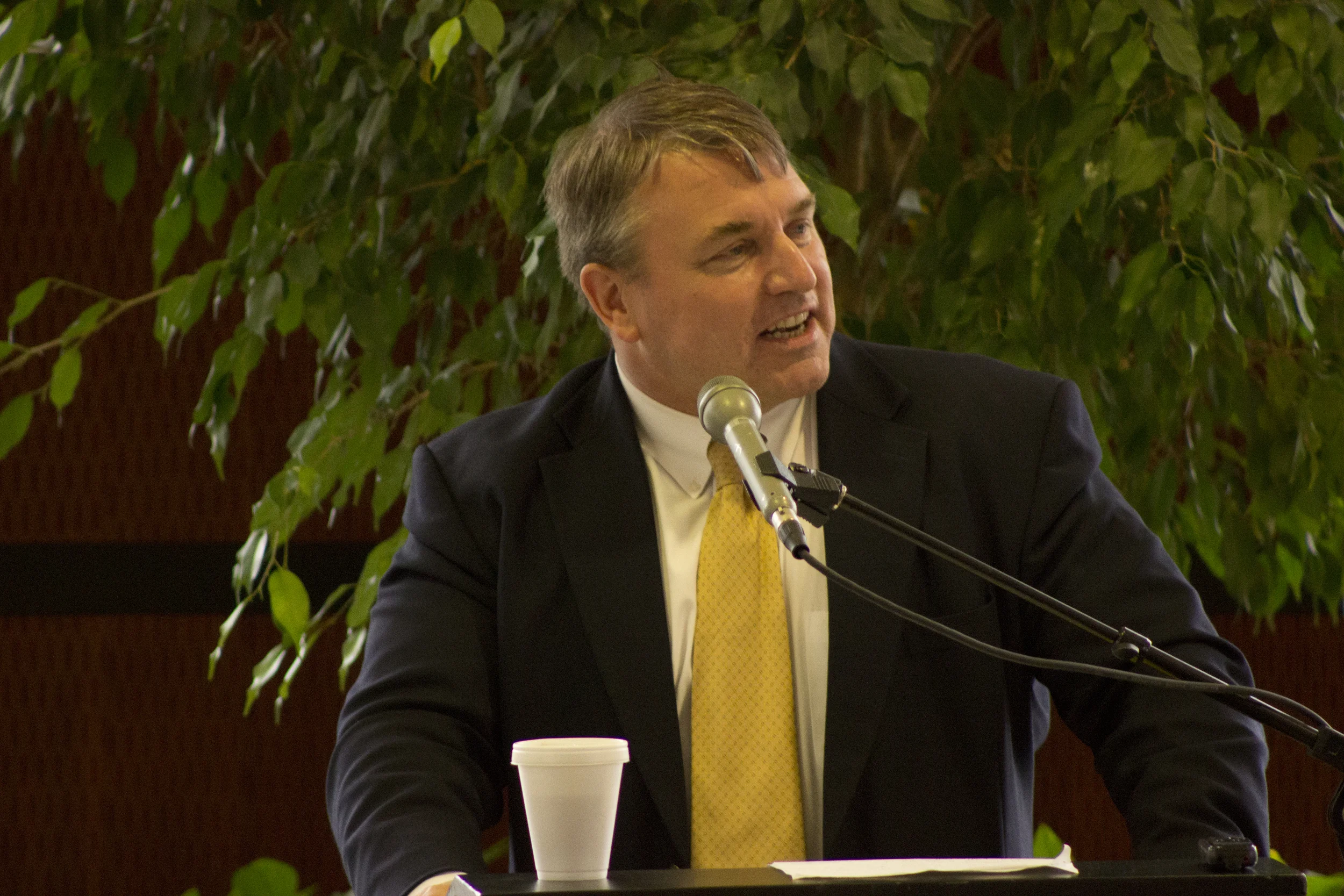
"Mind-blowing." That is how one student described Brad Gregory's talk, "The Reformation Era and the Making of Modernity," delivered last Wednesday, October 15, 2015, as part of Grand Rapids Notre Dame Alumni Club Hesburgh Lecture, and co-sponsored by Aquinas College's Catholic Studies Program and the Saint Benedict Forum.
Gregory began his talk by asking, "How did the world we live in today come to be as it is?" The West today, he argued, is characterized by pervasive all-encompassing institutions and market capitalism as well as a bewildering plurality of conflicting open-ended truth claims. How did we get this way? Most accounts begin with the the Enlightenment, the scientific and industrial revolutions, the American and French Revolutions, but Gregory argued that these, while important, must be understood in light of the 16th century doctrinal conflicts of the Reformation. And to understand the Reformation and its consequences, we need to understand the medieval world in which it occurred.
The medieval world was complicated and multi-layered, but one peculiar dimension of it is most notable: religion permeated every aspect of human reality. The Catholic Church was the recognized authority which governed the claims of that religion, so when the Reformation rejected the Catholic Church it was bound to affect all aspects of life which had been informed by those truth claims. This rejection and the rival claims to Christian truth had unintended--and undesirable--consequences for the future. With sensitivity and scholarly rigor, Gregory traced these unintended consequences from the rallying cries of the Reformers--"Here I stand" and sola Scriptura--to our contemporary situation. He claimed that the Reformers would be horrified by many aspects of our modern world, but they unwittingly set the stage for it.
Brad Gregory is Dorothy G. Griffin Professor of Early Modern European History at Notre Dame University. His talk was based on his recent book, The Unintended Reformation: How a Religious Revolution Secularized Society.
Being Transformed by the True, the Good, and the Beautiful: Joseph Pearce Speaks to Hope
Video Now Available: ...this was not the speech of a man who is merely academically interested in literary analysis, but was that of someone who has personally experienced divine grace firsthand.
by Rebecca Fox, Hope College Junior, English Major
When Joseph Pearce took the stage of Dimnent chapel last Wednesday, I’ll admit, he wasn’t who I was expecting. I’d been terribly excited all week that an Englishman was coming to Hope to give a talk on C.S. Lewis and J.R.R. Tolkien (my favorite novelists, Christian thinkers, and scholars). I suppose I’d been expecting a stuffy Oxford-type academic--perhaps wearing tweed and lecturing in a posh accent.
As Mr. Pearce delved into his passionate discussion of the Trinitarian nature of reality, I was immediately struck by three things. The first was that this man had a surprising and captivating London accent. He could have been attempting to impress upon me the importance of further regulation on the exportation of cheese curds and I would have been fascinated. More important, though, was the realization that the subject of God’s Truth, Goodness, and Beauty was intensely personal to Mr. Pearce. As I would find out later, he was not simply discussing an abstract idea, but was revealing the nature of his own intimate experiences with the Triune God.
Over lunch--hosted by the English Department’s Dr. Curtis Gruenler--Mr. Pearce conversed with several Hope students about the merits of having students use creative writing to explore and process great works of literature (in lieu of more traditional academic papers). In person, he was just as courteous and insightful as he had seemed on stage.
His afternoon lecture on the “Christian Imagination of C.S. Lewis and J.R.R. Tolkien” in the Martha-Miller Rotunda was full of eager students, faculty, and community members. Mr. Pearce’s insights inspired nearly half an hour of intense questions after his presentation. His talk ranged from the conversion of C.S. Lewis to the sanctification of the story and the richness of Christian allegory and symbolism in Lewis and Tolkien’s works. As he finished his lecture in a passionate analysis of Gollum as an instrument of divine grace, I was once again struck by his ardency: this was not the speech of a man who is merely academically interested in literary analysis, but was that of someone who has personally experienced divine grace firsthand.
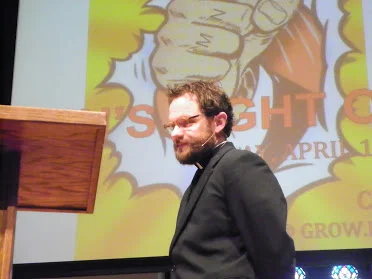
Joseph Pearce’s final talk revealed the depth of this truth. At 7:00 pm in Winants Auditorium, he gave his testimony to a rapt (and large) audience. As detailed in his recently published autobiography, Race With the Devil: My Journey from Racial Hatred to Rational Love, Mr. Pearce told his story: how God had rescued him from his life as a hate-filled skinhead. Punctuated with roughly sung snatches of anti-Catholic war songs, he told of his prison sentences and violent ideologies. The providential discovery of the writings of G.K. Chesterton (who was, subsequently, the subject of Pearce’s first book) and C.S. Lewis later were used as instruments of grace in Mr. Pearce’s own life. As such, Mr. Pearce’s conclusion was identification with John Newton’s famous hymn, Amazing Grace.
Having essentially spent the day with Joseph Pearce, I was left with the conviction that story (as Mr. Pearce said in his afternoon lecture) has indeed been sanctified by Christ and can be used by God to awaken the hearts of humankind. Even the heart of a man whose identity is in hatred can be transformed by such Amazing Grace.
These events were sponsored by the Saint Benedict Forum and co-sponsored by Hope College’s Campus Ministries, Dean of International and Multicultural Education, English Department, Political Science Department, Philosophy Department, and Religion Department.
The audio of Mr. Pearce's Chapel talk can be found here.
The video of "The Christian Imagination of C.S. Lewis and J.R.R. Tolkien" can be found here.
The video of "Race with the Devil: My Journey from Racial Hatred to Rational Love" can be found here.
All photos by Aaron Estelle
The Blessing of the Dorm Rooms
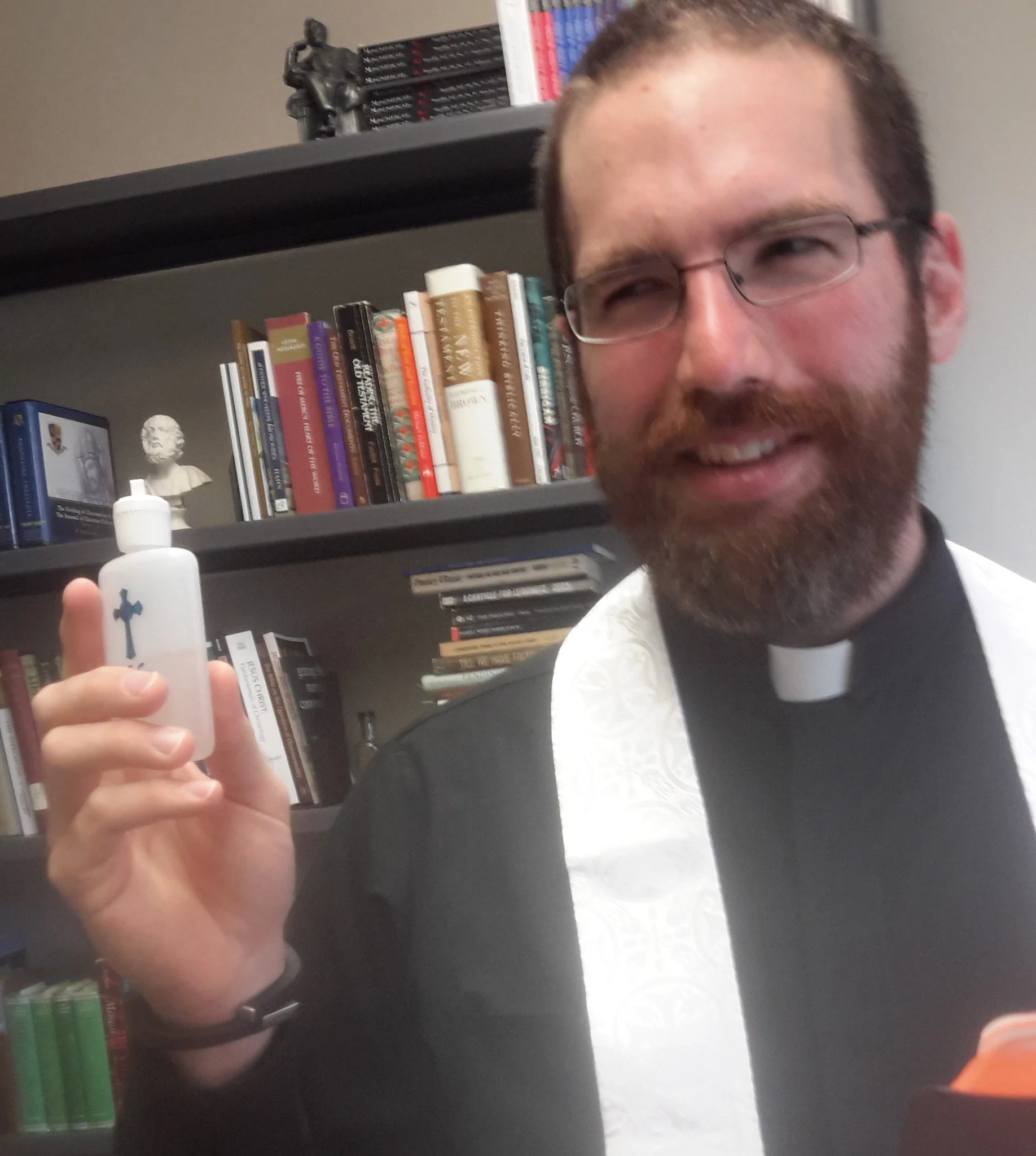
“Do you know how to make holy water?” Fr. Charlie asked. “You take ordinary tap water and boil the hell out of it.” Then he chuckled and apologized for the bad joke. But it seemed like a fitting comment to start his visit to Hope College that night. Fr. Charlie Brown, pastor of St. Francis de Sales Catholic Church in Holland, MI, was on campus last week to bless the dorm rooms. Fr. James VanderLaan, the associate pastor, accompanied him.
The blessing of dorm rooms is a common sight on Catholic college campuses, an annual tradition that marks the beginning of a new year. But this is the first time it has ever happened at Hope College. The event was organized by the Saint Benedict Forum.
“We wanted to find ways to bring our priests into closer contact with our Hope Catholic students,” said Dr. Jared Ortiz, assistant professor of Religion at Hope and Director of the Saint Benedict Forum. “Pope Francis says that the shepherd should smell like the sheep. And after walking through Durfee, our priests will surely do that . . . Just kidding (Sorry, Durfee).”
The dorm room blessing is rooted in the more traditional blessing of new homes. Since the students will be making these rooms their homes for the academic year, it seemed fitting to extend this blessing to dorms as well. “The blessing is not magic,” Dr. Ortiz insisted. “It is a way of consecrating our things—in this case our room—for a holy purpose. By blessing our home with holy water, we say that we will use our room for prayer, for study, for fellowship and not for anything contrary to God’s will. And the blessing helps to bring about this good intention.”
Before the priests blessed the rooms, they met students for dinner in the newly-renovated Phelps Dining Hall. Only a few students were scheduled to dine with the priests, but once they entered the dining hall such a large crowd gathered that two tables had to be put together.
After dinner, several students guided the priests to the rooms of the students who had signed up for a blessing. “It was great to be there,” Fr. Charlie said. “We got a lot of double-takes, but also a lot of smiling faces. I think people appreciated it.”
At each room, the priests would talk to the students for a few moments and then pray,
Lord, we have prepared a place for you here. Be with all who will live in this dorm room this semester, Bless their studies with your Spirit of Wisdom. Be their shelter when they are at home, Walk with them when they are away, And welcome every guest that comes to visit. And, when life’s journey is done, May they dwell with you in the place you have prepared for them in God’s House, Where you live forever and ever. Amen.
Then they would sprinkle holy water on all four walls of the room and say, “Let this water call to mind our baptism into Christ, who has redeemed us by his death and resurrection. Amen.”
During a breakfast for Hope students at St. Francis a few days before the blessings, Dr. Ortiz explained, “You don’t know who lived in your room before you or what they did there. Jesus talks a lot about demons and how they dwell in certain places. No amount of Windex can clean that out! Holy water will help.”
The blessing of dorm rooms was so warmly received by everyone involved that the Saint Benedict Forum wants to make this an annual tradition at Hope College.
Related Content: Holy Water Bucket Challenge for Demons
Fr. Damian Ference Preaches a Lenten Mission
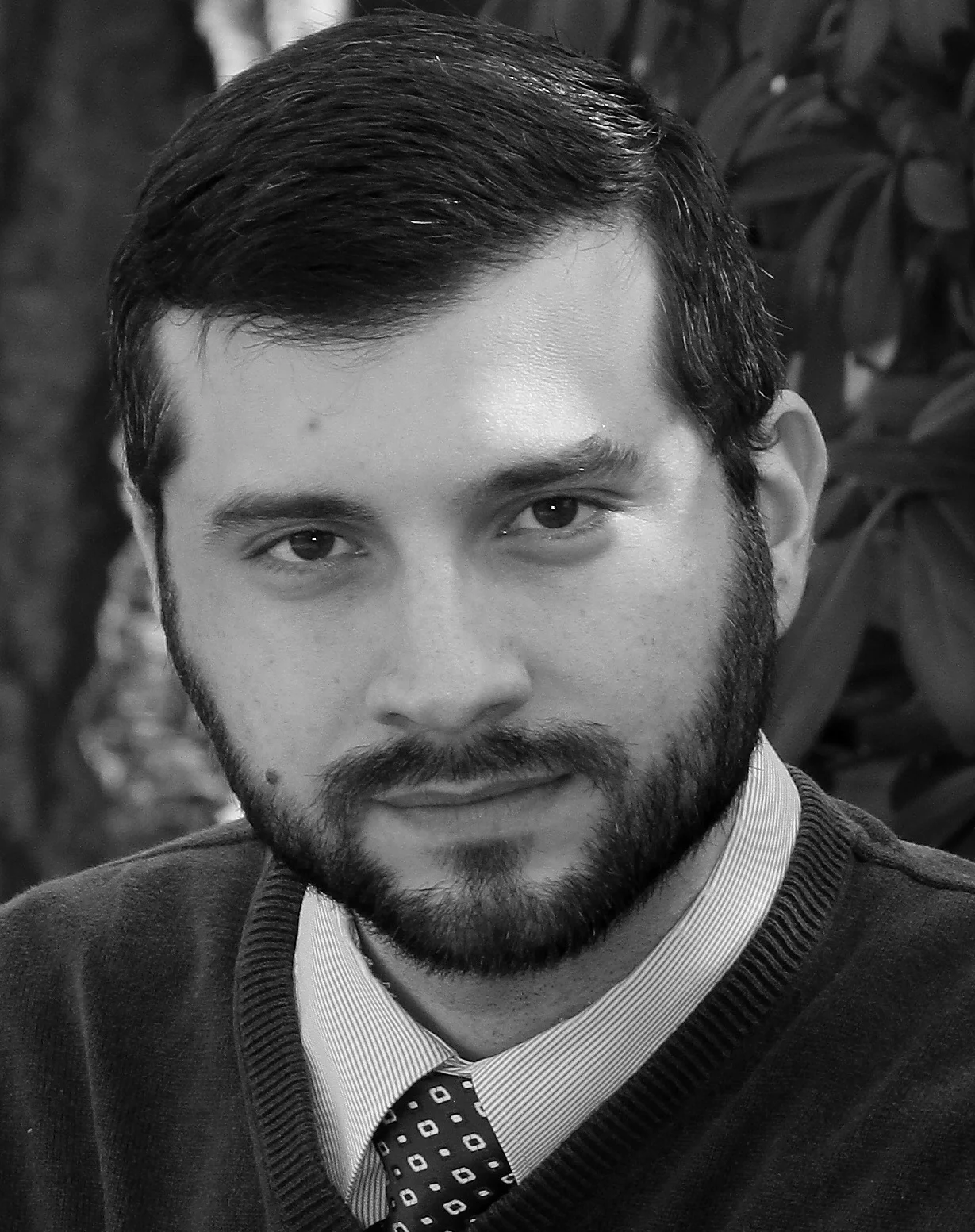
Fr. Damian Ference, a popular speaker and Assistant Professor of Philosophy at Borromeo College Seminary in Cleveland, OH, preached to a packed chapel and led a Lenten retreat with adoration and confession.
By Catie Gammon, Hope College Senior and President of the Union of Catholic Students
On April 9, 2014, the Saint Benedict Forum hosted Fr. Damian Ference, a popular speaker and Assistant Professor of Philosophy at Borromeo College Seminary in Cleveland, OH. His visit was co-sponsored by Hope College’s Campus Ministries, the Religion Department, and the Union of Catholic Students.
Fr. Damian’s day began with a riveting talk to a packed chapel of Hope College students. He brought plenty of energy as he spoke about Christian identity. Preaching from Mark’s account of the baptism of Christ, Fr. Damian pressed the campus to think about who we are and whose we are. By virtue of our own baptism, God sees us as beloved sons and daughters. Fr. Damian challenged cultural lures to find love in other places than in Christ through numerous amusing examples. “God sees us not as the sum of our weaknesses, but of our Father’s love for us.” Catholic and non-Catholic students alike were captivated by his wisdom and impressed at the refreshing way he presented biblical truths!
After joining a few students for lunch, Fr. Damian presented a lecture on vocations to Dr. Jared Ortiz’s Catholic Christianity class. He deepened the class’ understanding of John Paul II’s Theology of the Body by talking about how we are all made for union, made to give ourselves away. We are all made for marriage, whether as husbands and wives or as celibates who are married to Christ or the Church. We learned that vocations to the religious life are a direct union with Christ and with His church, modeling a beautiful sacrificial life for us all.
The culmination of Fr. Damian’s day at Hope was his preaching of a Lenten Mission, “Nothing Scares Jesus.” Once again, he delighted and moved the audience with his passionate storytelling and powerful theological insights.
Using Mark’s account of Jesus healing the Gadarene Demoniac, “the most Flannery O’Connoresque story in the Bible,” Fr. Damian unpacked the story verse by verse. The unnamed demoniac represents ourselves, who chained in our state of sin harm ourselves and others. However, Jesus enters in to the forbidden, ugly, and unclean territories of our lives and heals us with His kindness, mercy, and compassion. Christ even has the power to turn our vices into our victories!
The talk was followed by an hour of adoration and time for confession which served as a wonderful time to reflect on this message of Christ’s mercy and to prepare many of students and faculty for Holy Week and Easter.
We were very blessed to host Fr. Damian’s first ever visit to Hope College and look forward to his return soon!
Media The audio of Fr. Damian's Chapel talk, "Who Am I? Whose Am I?" can be found here.
The video of Fr. Damian's Lenten Mission, "Nothing Scares Jesus," can be found here.
Radio Interview about the Saint Benedict Forum
Dr. Jared Ortiz, co-founder and director of the Saint Benedict Forum, recently spoke about the Saint Benedict Forum and what it means to be Catholic at Hope College on Holy Family Radio's Faith & Reason show with Dr. John Pinheiro.
Dr. Jared Ortiz, co-founder and director of the Saint Benedict Forum, recently spoke about the Saint Benedict Forum and what it means to be Catholic at Hope College on Holy Family Radio's Faith & Reason show with Dr. John Pinheiro. The complete interview can be found here.