An Interview with Educator & Scholar Zena Hitz
On November 10, Saint Benedict Institute co-founder Jared Ortiz was invited to interview educator and scholar Zena Hitz, author of Lost in Thought: The Hidden Pleasures of an Intellectual Life (Princeton University Press, 2020).
On November 10, Saint Benedict Institute co-founder Jared Ortiz was invited to interview educator and scholar Zena Hitz, author of Lost in Thought: The Hidden Pleasures of an Intellectual Life (Princeton University Press, 2020). This event was presented by the Lumen Christi Institute at the University of Chicago. The following excerpt has been lightly edited for clarity. Watch the full, archived interview here: https://youtu.be/7iVhIlDkrVI.
Jared Ortiz: Let’s start with the prologue you wrote with the delightful title, “How Washing Dishes Restored My Intellectual Life.” Classically, servile labor is always contrasted with the intellectual life. Even today, we often see this as a hindrance or a distraction from our real work. So start us off by telling us how washing dishes restored your intellectual life.
Zena Hitz: As far as washing dishes and intellectual life, I think it’s helpful to first recognize that our culture disassociates our work from the obvious human good that it is meant to produce. You can work away at something without really knowing why it matters.
I went to a wonderful liberal arts college, St. John’s, where I teach now, which matured my intellectual interest. I learned how to sit with a difficult text or a difficult question and work through it. Then I went to graduate school because I was in love with learning and I wanted to do more of it. I became a professional academic scholar in classical philosophy. But I got sucked into the prestige and status game that happens in various parts of academia. I lost touch with what I was doing. I didn’t like factory style teaching in large classrooms. I had to reduce the books we were reading to bullet points and evaluate how well they were absorbed. Many of my students were there to fill a requirement and never caught the bug. It felt mechanical. So I quit.
I went and lived in a religious community in Canada for a time and it was very focused on manual labor and poverty. It was there that I lived a very full human life and had everything I could ever want except for an intellectual life at the level of intensity I was accustomed to. I had to think hard about why it [the intellectual life] mattered, why it mattered for me and why it might matter for the kinds of people I was around who were from all walks of life, all levels of interest. The book came out of that experience from living in a very basic way and having a chance to think about why the intellectual life mattered.
The Return of Courtship, Marriage, and Sex
In today’s society, there is very little instruction about how to navigate the world of love and romance. For this reason, we decided to bring back our series, “Courtship, Marriage, and Sex.”
Rhonda and Jared Ortiz co-hosted this online event with Jack and Melissa Mulder.
In today’s society, there is very little instruction about how to navigate the world of love and romance. For this reason, we decided to bring back our series, “Courtship, Marriage, and Sex.”
This year, the two-week seminar took place on Zoom. Jared and Rhonda Ortiz led the first seminar on courtship. Jack and Melissa Mulder led the second seminar on marriage and sex. We interviewed both couples:
What is the current dating culture like at Hope College?
Ortizes: At Hope, there is a gender imbalance where women significantly outnumber men. Also, there are many factors working against a healthy dating culture: lack of wholesome examples, delayed maturity, exposure to pornography, fear of failure and of commitment, rising passivity among men, and so on. Young people have never been taught how to think about romance, how to navigate their emotions and sexual desires, or how to find and win the right one.
Mulders: Even ignoring the situation with the pandemic, to a large extent dating seems almost nonexistent. The idea that someone would get together with one person he or she was romantically interested in, rather than a group of friends, seems difficult to imagine for a lot of people.
Why is it important to talk about courting/marriage?
Ortizes: Short of following Jesus, choosing a husband or wife is the most important decision you're ever going to make, and courtship helps you make it. Also, so many students have not witnessed solid, faithful marriages. Showing that you can make a good choice and still love (and like!) each other for 20 years is extremely important.
Mulders: Courtship sounds a bit antiquated, but it holds principles that can teach young people how to find someone and be with them in such a way that they establish a strong foundation for a lasting marriage.
If you could leave students with one piece of relationship advice, what would it be?
Ortizes: Don't sit on the couch! That is the most practical one for maintaining a chaste courtship and discerning the character of the other person. But more than this, young people should speak honestly about important things. They should get on the same page early about proper boundaries, what they want from the relationship (discerning marriage), and what they think about the most important things (God, children, parents, etc.).
Mulders: Communicate openly with your significant other. Don't assume that they magically understand your expectations or share your values. If you're able to establish a solid relationship by hashing out the tough stuff everything else will be easier. Other than that...take long walks, develop interests together, help each other with one another’s burdens, big or small.
Hope Students Featured in Faith Grand Rapids December Issue
Caryn and fellow classmate Jacob Kelley, a senior at Hope College, were recently featured in Faith Grand Rapids, the official magazine of the Diocese of Grand Rapids.
“I feel very close to Jesus, a closeness I didn’t feel when I entered college,” begins Caryn Dannah, a junior at Hope College who is involved in Saint Benedict Institute and the Hope Catholics student group.
Caryn and fellow classmate Jacob Kelley, a senior at Hope College, were recently featured in Faith Grand Rapids, the official magazine of the Diocese of Grand Rapids. In their interviews, each mentioned how important it was having a strong Catholic community to support them in their faith journeys.
“I had never truly had a Catholic community of peers, and I didn’t realize how desperately I wanted and needed such a community until I finally found one. The people in this community have deepened my faith in ways I could never have imagined…” Jacob said.
To read both interviews, download the PDF excerpt or view the article in the December 2020 issue at the Diocese of Grand Rapids website.
Shared with permission from the Diocese of Grand Rapids.
Leave Room for Jesus: an Advent Reflection
This past August, Hope College alumnus Jacob Mazur-Batistoni (‘20) began his Novitiate with the Dominican Friars of the Province of St. Albert the Great. With Brother Jacob’s permission, we are pleased to reprint his recent reflection on Advent.
This past August, Hope College alumnus Jacob Mazur-Batistoni (‘20) began his Novitiate with the Dominican Friars of the Province of St. Albert the Great.
With Brother Jacob’s permission, we are pleased to reprint his recent reflection on Advent below.
To learn more about Brother Jacob’s vocation and his time of involvement with Saint Benedict Institute and Hope Catholics, click here and here.
___________________
LEAVE ROOM FOR JESUS
A Reflection on Prayer and Fasting
Br. Jacob Mazur-Batistoni
As Advent has just begun, I have been considering what I will do to prepare for the coming Emmanuel. How is the Lord calling me to have the Incarnate Word dwell deeper in my heart? Looking back, this has been a common theme in my life – how do I leave room for Jesus? At times I have had “no room in the inn” (Luke 2:7). For Christians throughout all times and places, as has been in my own life, prayer and fasting have been an important response to the invitation Christ offers to us all this Advent season: to leave more room for Him to dwell more fully in our lives.
Christ’s Invitation to Leave Room in My Life
There have been two significant encounters with Christ in my life that I would consider moments of conversion. Both involved making more room for Jesus.
The first encounter was the summer before I started college. In a profound encounter with Jesus in Eucharistic Adoration, he invited me to hand all the things that were crowding my soul over to him. When I said yes, Jesus took the burdens from me and filled me with his peaceful presence. This kind of “making room” was simply a prayer from the heart.
The second encounter was during my sophomore year of college. In the midst of trying to discern God’s will for my life, I attended a charismatic Catholic conference. Here, Jesus asked for me to make even more room for him – to surrender my hopes and dreams for the future by discerning the priesthood. Essentially, to trust in His mercy and providence.
After experiencing this call, I desired to give more of myself to Christ. This is when I began to pray and fast. I did three day fast from all foods and had a very fruitful experience. Since then, I have done more fasting of varying intensity. A few of the longer ones involved participating in Exodus 9o, a 90-day fast from media, desserts, and other comforts of life.
Fasting became a tangible, physical way to make room for Jesus in my life and to grow in self-control over my desires and emotions. Through suffering hunger and physical emptiness, I united myself with Christ’s suffering. While fasting, I came to realize that getting irritable was a choice and that my physical discomfort did not have to cut me off from the joy and peace of Christ. I learned to turn to Christ for strength on a daily and, at times, hourly basis – something that each person needs to learn. Recently, Jesus has expanded his residence in me by guiding me to the Dominican novitiate. Now, I’m asking myself how to engage Advent in the midst of a year dedicated to formation and discernment.
Prayer and Fasting in the Context of Relationships
A critical component of fasting is prayer. If one fasts without engaging in a life of prayer, it turns the fast into a health fad or a challenge to conquer, instead of a way to enter relationship with Christ. Prayer could be the Rosary, Lectio Divina, or just sitting in silence with God. Prayer is how we enter into relationship with God, and when fasting for spiritual purposes, one should be striving for this relationship.
Along with praying during a fast, one should pray before a fast to discern what your fast should look like. This is best done with a trusted mentor (a spiritual director, if possible) or a friend that can help you listen to God. In all things, you should pursue what is appropriate for your physical, emotional, and spiritual health. For some, a good fast might be to give up social media. For others, it could be giving up eating snacks. It depends on where God is leading the person at the time.
Fasting has a long history in the Church and touches more of the life of the Church than just the Lenten fast, perhaps a surprise to most Roman Catholics. In the Eastern Christian traditions, they have fasting seasons during Advent (the Nativity Fast), after the Easter season (the Apostles Fast), in August (the Dormition Fast), and during Lent. These practices are slowly being adopted by some Roman Catholic as a way to adopt the Church’s liturgical rhythm in their spiritual life. The liturgy helps to make spiritual practices more communal and less individualized. Fasting could be with two or three people, a small group, or even an entire parish. This helps remind us of the communal support we need in the spiritual life and that this journey is not “just about me.”
Fasting, as a spiritual practice, is primarily a recognition of our weakness and need for Jesus, more than it is a sign of our strength. Without Christ, and our sisters and brothers, it is easy to be deceived or discouraged when taking up the practice of fasting.
Why You Should Consider Fasting This Advent
The strong words of the Gospel challenge us. Jesus does not say when the bridegroom is away, they might or if they feel like it will fast in those days. Jesus said they will fast (Luke 5:35). As the Church today, we ought to consider how Jesus is inviting us to fast. This type of self-denial is not an optional practice, but a key part of following Jesus.
Thankfully, since the Bridegroom has been away, He sent us His Spirit. The Holy Spirit bestows many gifts upon God’s people, but are we willing to make room for the Spirit?
During this Advent season the question is posed in a striking way – will you leave room for Jesus? Or is there no room in the inn?
#GivingTuesday 2020
Please consider making a gift to support our ministry at Hope College. Throughout the months of October and November we have shared several stories from our students and alumni. They are beautiful accounts of community, sacramental life, and prayer. By giving to the Saint Benedict Institute your generosity can help foster many new stories in the lives of students at Hope College in the years to come.
Giving Tuesday Supporting the Saint Benedict Institute
Today is #GivingTuesday! Please consider making a gift to support our ministry at Hope College. Throughout the months of October and November we have shared several stories from our students and alumni. They are beautiful accounts of community, sacramental life, and prayer. By giving to the Saint Benedict Institute your generosity can help foster many new stories in the lives of students at Hope College in the years to come.
Check out our featured students below!
"This is a particularly turbulent year to be entering post-Hope College life… Being in a new place has re-emphasized how profoundly this community has impacted me, and continues to do so."
Read Alicia's story
"This time, even though uncertain, has demonstrated that the environment can change, but Jesus’ presence and help is constant… I have always related the sun’s warmth to Jesus’ warmth and sitting outside during Mass, I can feel Him shining upon me."
Read Kimberly's story
"God has been working in the Ignis community to bring students closer to Him and to each other. These relationships are needed now more than ever, and the fruit from these relationships has been carrying the members of Ignis through both the hills and valleys of the semester."
Read the Ignis Update
"I have found a true community with people who challenge me to look on the bright side and focus my attention on those things greater than evil… No matter the struggles, I know relationships will always remain."
Read Katherine’s Story
Student Stories: The Freshman Experience
This semester has been challenging in a multitude of ways. People say, “Keep it up” or my favorite phrase, “you’re living through history right now!” As true as that may be, it doesn’t take away from the difficulties this unforeseen virus has brought to our world. As a freshman living in the COVID-19 pandemic, there remains a mix of emotions about the new life, and also new limitations and guidelines, I am experiencing.
When I first started at Hope, I was overjoyed to be on campus and that remains true to this day after seeing how many schools have been shut down. However, I have encountered academic struggles, homesickness, and limited opportunities to get to know people. This semester is shorter, but the workload remains normal. Extra time spent doing online work keeps me pent up in my room more than I enjoy. Homesickness has also been more prominent as the lack of breaks means more days between seeing my family and friends back home. Lastly, it is hard to meet people outside of my dorm building. I am a social butterfly, even still spreading my wings to other communities proves difficult with masks and the 6 ft. distance rule.
Upon joining Hope Catholics, I have found a true community with people who challenge me to look on the bright side and focus my attention on those things greater than evil. I have found a church and home with people who hold the same core beliefs that I do. I have had opportunities to join a Bible study, participate in a women's group, go to Mass, receive guidance in my faith and life, and hang out with genuine individuals. I can’t wait to see everything else I will experience with these new friends. No matter the struggles, I know relationships will always remain. I believe the book of Romans sums it up best when it reads, “Do not be overcome by evil, but overcome evil with good” (Romans 12:21).
Katherine is a freshman from Chesterfield, MO. It may be too soon to be sure, but she is planning to major in Religion and Psychology. Fun fact: Katherine is a blackbelt in taekwando!
Student Stories: Ignis Update
Last year we shared a story about a student prayer group called Ignis that was started by a recent graduate. Here is a reflection written by a few of the group members on how they have been creating community during the coronavirus pandemic.
Student Stories: Ignis Update
Last year we shared a story about a student prayer group called Ignis that was started by a recent graduate. Here is a reflection written by a few of the group members on how they have been creating community during the coronavirus pandemic.
In these strange and trying times, community can be hard to come by. Ignis has been working to provide Hope College students with an intentional Catholic community centered on prayer. Since being back on campus, the group has been meeting in-person on Monday evenings to pray with and for one another. While these meetings logistically look different than in previous semesters, the opportunity to meet and pray in-person has been a blessing for the members of this community. Students have also been spending time together on the weekends, enjoying fellowship, faith, food, reflection, and more. God has been working in the Ignis community to bring students closer to Him and to each other. These relationships are needed now more than ever, and the fruit from these relationships has been carrying the members of Ignis through both the hills and valleys of the semester.
COVID-19 and the Worldwide Church
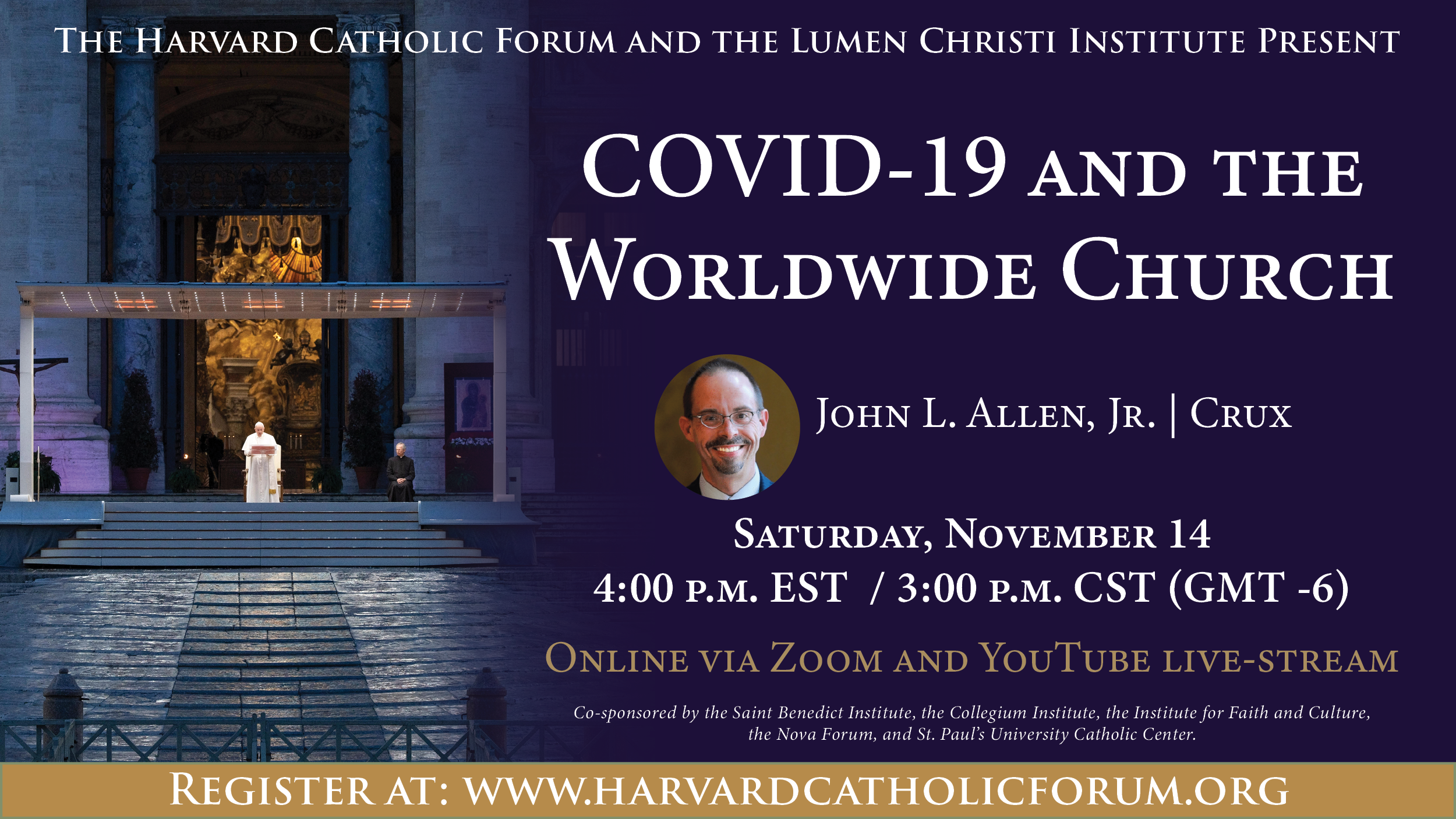
Join us at 4 p.m. EST/3 p.m. CST on Saturday, November 14th as we cosponsor a Zoom webinar with the Harvard Catholic Forum and the Lumen Christi Institute. The John L. Allen Jr. will present “COVID-19 and the Worldwide Church.” The Saint Benedict Institute is a cosponsor of this event. Registration is required to join the Zoom webinar.
COVID-19 and the Worldwide Church
Saturday, November 14, 2020
4:00 p.m. EST
Register for Zoom
Join us at 4 p.m. EST/3 p.m. CST on Saturday, November 14th as we cosponsor a Zoom webinar with the Harvard Catholic Forum and the Lumen Christi Institute. John L. Allen Jr. will present “COVID-19 and the Worldwide Church.” The Saint Benedict Institute is a cosponsor of this event.
This webinar is free and open to the public. The event will be presented on Zoom (registration required), as well as through live-stream on YouTube. For more information and to register for this webinar, click here.
The pandemic of 2020 has disrupted the sacraments and public worship, scattered communities, and put local churches into new, sometimes strained, relationships with civil authorities. The Church has also been a significant actor in the crisis, offering relief services and spiritual care on a massive scale. What does all this mean for the worldwide Church, now and in the years to come?
John Allen is the Founder and Editor of Crux, an independent online news website reporting on the Catholic Church. As a journalist, his work has appeared in Crux, The Boston Globe, The National Catholic Reporter, The New York Times, The Tablet, CNN, and many other outlets. He is the author of numerous books, including The Catholic Church: What Everyone Needs to Know (Oxford University Press, 2014), and A People of Hope: The Challenges Facing the Catholic Church and the Faith That Can Save It (Image, 2013), co-authored with Timothy Cardinal Dolan.
Quo Vadis: The Direction of Eastern Catholic Theology, a Pastoral Perspective for the 21st Century
Join us at 7 p.m. CST/8 p.m. EST on Thursday, November 12th as we cosponsor a Zoom webinar with the Lumen Christi Institute. The Most Rev. Borys Gudziak will present “Quo Vadis: The Direction of Eastern Catholic Theology, a Pastoral Perspective for the 21st Century,” the final presentation in the fall webinar series Eastern Catholic Theology in Action.
Quo Vadis: The Direction of Eastern Catholic Theology, a Pastoral Perspective for the 21st Century
Thursday, November 12, 2020
8:00 p.m. EST
Register for Zoom
Join us at 7 p.m. CST/8 p.m. EST on Thursday, November 12th as we cosponsor a Zoom webinar with the Lumen Christi Institute. The Most Rev. Borys Gudziak, who is Archbishop-Metropolitan of the Ukrainian Catholic Archeparchy of Philadelphia, will present “Quo Vadis: The Direction of Eastern Catholic Theology, a Pastoral Perspective for the 21st Century.” This presentation concludes the fall webinar series Eastern Catholic Theology in Action. The Saint Benedict Institute is a cosponsor of this event series.
This webinar is free and open to the public and no preparation is necessary. The event will be presented on Zoom (registration required), as well as through live-stream on YouTube. For more information and to register for this webinar, click here.
Metropolitan Borys Gudziak has spent his life committed to Catholic education. He helped to found Ukrainian Catholic University in Lviv, the only Catholic University between Poland and Japan. The University’s mission was simple: to bring the Christian humanist vision of the Catholic University to Ukraine to heal the wounds inflicted by Soviet oppression. Gudziak was rector of Ukrainian Catholic University until 2012 and became president upon his episcopal ordination. After seven years as ordinary for Ukrainian Catholics in France, Belgium, the Netherlands, Luxembourg, and Switzerland he was named metropolitan archbishop of the Ukrainian Catholic Archeparchy of Philadelphia in 2019. From the depths of his experience living between continents, eastern and western Europe, the academy and pastoral life, Gudziak will offer a pastoral perspective on the Eastern Catholic theological voice and its role in communicating the Gospel today.
The Most Rev. Borys Gudziak (Ph.D. Harvard University, S.E.O.L Pontifical Oriental Institute) is Archbishop-Metropolitan of the Ukrainian Catholic Archeparchy of Philadelphia. Archbishop Gudziak also serves as a member of the Permanent Synod of the Ukrainian Greek Catholic Church and as a head of the Department of External Church Relations. Before being appointed to the Archeparchy of Philadelphia, Archbishop Gudziak served as bishop of the Ukrainian Greek Catholic Church in France, Belgium, the Netherlands, Luxemburg and Switzerland. He has spoken and written widely concerning theology, education, and political, cultural, and religious affairs. He is author of Crisis and Reform: The Kyivan Metropolitanate, the Patriarchate of Constantinople, and the Genesis of the Union of Brest (Harvard University Press, 1998), as well as numerous articles in European and North American academic journals. Archbishop Gudziak has played an integral role in reviving the Ukrainian Catholic Church following the collapse of the Soviet Union, including helping to re-establish the Ukrainian Catholic University, eventually serving as its rector from 2002-2013, and as its President starting in 2013. He is the recipient of the Antonovych Prize (2006), the Jan Nowak-Jeziorański Award (2016), and the Notre Dame Award, presented by the University of Notre Dame (2019). He was made a Knight of the French Legion of Honor in 2015.
Thinking Inside and Outside the University: Zena Hitz on the Inner Life
On Tuesday, November 10th, Saint Benedict Institute co-founder Jared Ortiz will interview Zena Hitz on her new book Lost in Thought . The discussion will take place at 6:00 pm EST/5:00 pm CST and is free and open to the public. This event will be held online through Zoom (registration required) and YouTube live-stream. This event is presented by the Lumen Christi Institute as part of its Liberal Arts Colloquium. The Saint Benedict Institute is a cosponsor.
Thinking Inside and Outside the University: Zena Hitz on the Inner Life
Tuesday, November 10, 2020
6:00 PM EST/5:00 PM CDT
Register for Zoom
On Tuesday, November 10th, Saint Benedict Institute co-founder Jared Ortiz will interview Zena Hitz on her new book Lost in Thought. The discussion will take place at 6:00 pm EST/5:00 pm CST and is free and open to the public. This event, “Thinking Inside and Outside the University: Zena Hitz on the Inner Life” will be held online through Zoom (register for Zoom here) and YouTube live-stream. This event is presented by the Lumen Christi Institute as part of its Liberal Arts Colloquium. The Saint Benedict Institute is a cosponsor.
In a world where efficiency and utility are the standards by which we measure success, how do we appreciate what resists quantification? And at a moment of institutional change and instability for higher education, what do we hold onto?
In her new book, Lost in Thought, Zena Hitz lays out the case for the inner life as a good in itself. Today, when even the humanities are often defended only for their economic or political usefulness, Hitz says our intellectual lives are valuable not despite but because of their practical uselessness. Within or without institutional structures, the intellectual life offers a source of meaning and fulfillment.
In this webinar conversation with Jared Ortiz, Hitz will elucidate the hidden pleasures of contemplation, assess the possibilities for its re-emergence in the contemporary university, and debate whether figures as dissimilar as the Virgin Mary, Albert Einstein, and Malcom X can be said to participate in a common intellectual activity.
Zena Hitz is a Tutor at St. John’s College. She holds a BA from St. John’s College, an MA from Cambridge, and a PhD from Princeton. Prior to teaching at St. John’s, she taught philosophy at Auburn University and the University of Maryland Baltimore County. She is author of Lost in Thought: The Hidden Pleasures of an Intellectual Life (Princeton University Press, 2020), and has recently begun the Catherine Project, an online non-credit Oxford-style tutorial program on great books and fundamental questions. She is the recipent of the 2020 Hiett Prize in the Humanities.
Jared Ortiz is Associate Professor of Religion at Hope College and Executive Director of the Saint Benedict Institute. He holds a BA from the University of Chicago, an MA from St. John's College, and an MA and PhD from Catholic University of America. Prof. Ortiz works on Latin patristic thought, especially St. Augustine. His current research is in the themes of politics, holiness and disability in Augustine’s City of God. He is author of You Made Us for Yourself: Creation in St. Augustine's Confessions (Fortress Press, 2016).
Student Stories: Mass on the Lawn
This semester has looked a bit different. We were unable to use our normal space for Mass so we have been meeting outdoors on a lawn near campus. This has been a unique experience for our students. Here is a reflection from one of our seniors:
Throughout quarantine, not having Mass in person was hard. The change and uncertain feeling of when we could resume normal in-person events increased my stress and discomfort. Even after my hometown church opened back up, it was still different, and I had a hard time adjusting to the change. When coming back to Hope, I was unsure about how Mass was going to be due to dioceses having different regulations to follow. After hearing that we were not able to have Mass on campus, I was disappointed and was a little worried about what going to church would look like this semester.
Even during this time of change and difficulty, adjusting to having outdoor Mass near campus has been a blessing. I love the feel of going to outdoor Mass and have even connected more with friends and peers due to this opportunity. One week, I invited a friend to come with me to Mass and now we walk and sit together on our blankets every week. I have also connected to peers more by having the opportunity to eat ice cream together outside after Mass and I have enjoyed doing outdoor activities with the Hope Catholics students. This time, even though uncertain, has demonstrated that the environment can change, but Jesus’ presence and help is constant. He is always there for us and His presence in the Sacrament of the Eucharist will never change, no matter the location. I have always related the sun’s warmth to Jesus’ warmth and sitting outside during Mass, I can feel Him shining upon me.
Kim Paquette is a senior from Hartland, MI. She is studying biology and psychology. After graduation she hopes to attend medical school.
Photos below were taken on Sunday, August 16th, 2020 during the first Mass of the fall semester.
Student Stories: Exodus After Hope
This year Fr. Nick and Carly launched the Exodus 365 program. The idea of Exodus 365 is to help students engage in the spiritual life every day knowing that some seasons will be more intense than others. (Read more about Exodus 365 here on our website.) Some of the participants are Hope alumni affectionately known as the ‘away team’. We asked one of those graduates to reflect on her experience so far. Here is what she had to say:
Exodus After Hope
This year Fr. Nick and Carly launched the Exodus 365 program. The idea of Exodus 365 is to help students engage in the spiritual life every day knowing that some seasons will be more intense than others. The students take on 90 days of the full Exodus program spread throughout Lent, Advent, and in week long intervals during the traditional Ember days. This includes various types of dietary and electronic fasting as well as cold showers. In between these seasons is a low intensity program that includes small group meetings, prayer, exercise, a healthy sleep schedule, and a discipline of the student’s choosing. Some of those groups are made up of Hope graduates affectionately known as the ‘away team’. We asked one of those graduates to reflect on her experience so far. Here is what she had to say:
This is a particularly turbulent year to be entering post-Hope College life, and I’m glad to have a connection back to the Hope Catholic community through Exodus 365. Being in a new place has re-emphasized how profoundly this community has impacted me, and continues to do so. It’s also nice to see familiar faces every week via Zoom; I’m especially grateful for my accountability partner, who is also a recent Hope graduate and Exodus veteran. We’re facing a lot of similar challenges, so we can connect on many things and offer prayers for each other in our daily experiences. In terms of the disciplines themselves, the yearlong program with seasons of higher and lower intensity is definitely unique. I’ll admit, at times I’ve been reluctant to dive into a high-intensity week, especially when one coincided with my first week of graduate classes (when one longs for the comforts of warm showers, chocolate… and maybe a drink). But the increased structure was actually reassuring amidst figuring out a hectic new schedule, and of course, prayer is the best solace of all. Overall, I’m very grateful to be doing Exodus 365 as a graduate.
Alicia Bostwick graduated from Hope in May. She studied biology and was a member of the cross country team. In August, Alicia began her first year of graduate school at Dartmouth College where she is studying molecular and cellular biology.