Calendar of Events 2015-2016
Dawn Eden on Chastity, Duncan Stroik on Architecture for the Poor, Anthony Esolen on the Liberal Arts, Spiritual Friendship authors on being gay and Christian, Sr. Miriam James Heidland on hope...check out our upcoming events.
Dawn Eden on Chastity, Duncan Stroik on Architecture for the Poor, Anthony Esolen on the Liberal Arts, Spiritual Friendship authors on being gay and Christian, Sr. Miriam James Heidland on hope....check out our Calendar of Events 2015-16.
Dr. Ortiz on the Journey Home (VIDEO)
Cradle Catholic and director of the Saint Benedict Forum, Jared Ortiz, tells the harrowing tale of how he drifted away from God in his youth and how God slowly drew him back through providential encounters with Muslims, Jews, a few Catholics, and reading a lot of books. Watch it here:
Have a Heart: Dr. Anthony Esolen on the Value of a Christian Liberal Arts Education (VIDEO)
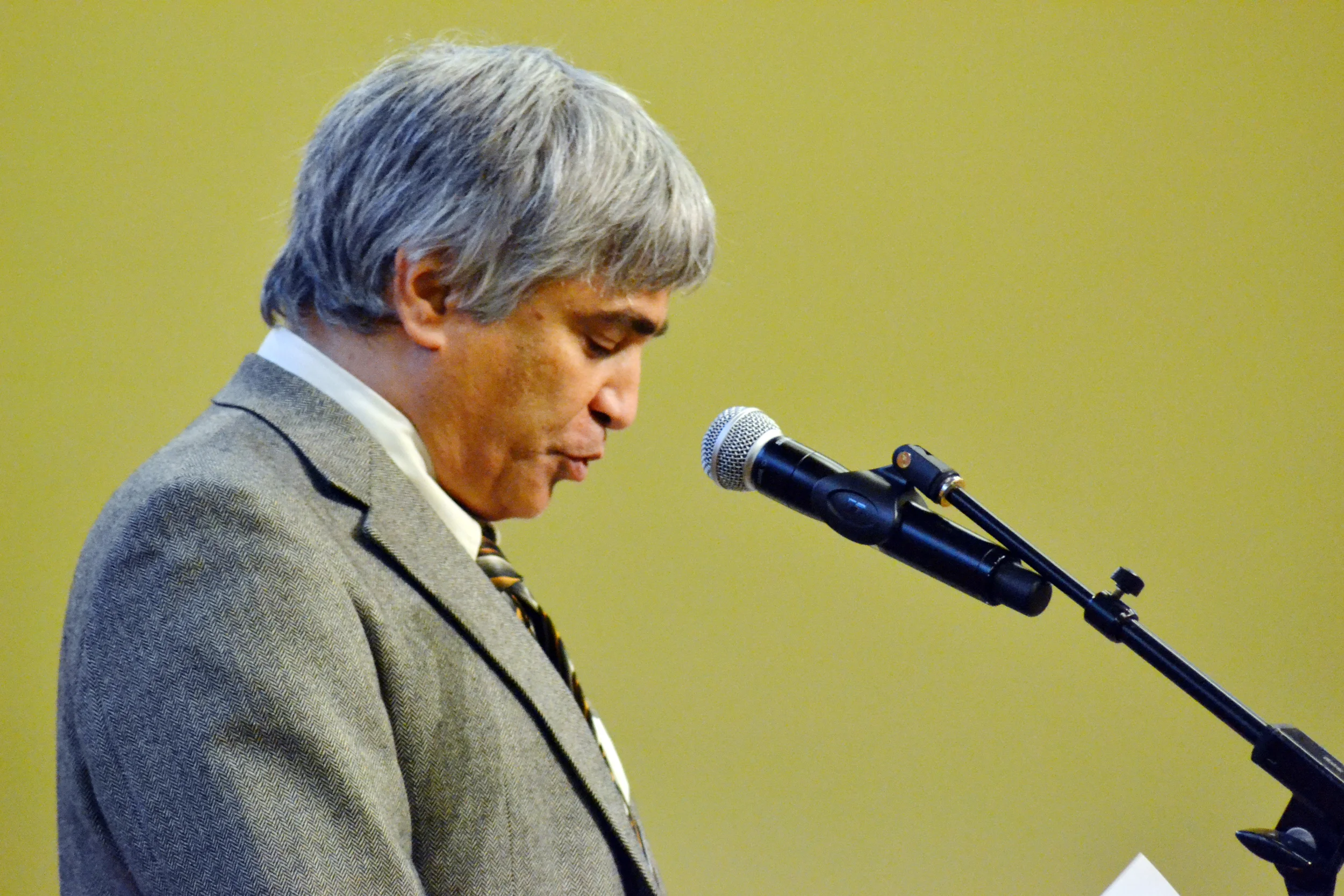
Dr. Anthony Esolen of Providence College lectured on “Liberal Arts and the Christian College in a Post-Christian World.” Dr. Esolen spoke of the rare and precious gift that only a Christian liberal arts college can bestow - an education with a heart.
by Maria Gowon, Public Accounting Major, Class of 2016
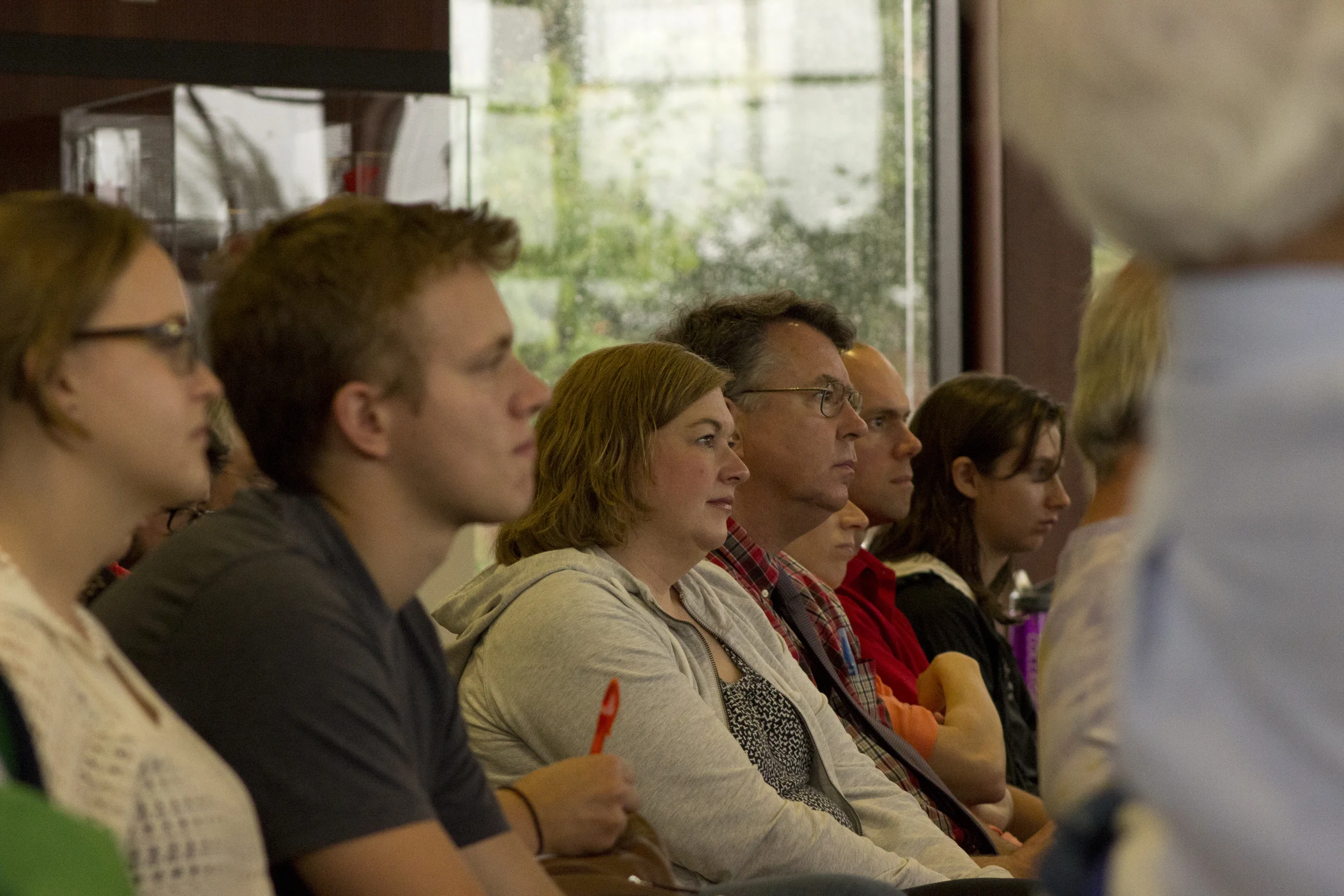
Dr. Anthony Esolen of Providence College lectured on “Liberal Arts and the Christian College in a Post-Christian World.” His lecture drew an eclectic group of educators, students, clergymen and the general public. His talk was similarly eclectic, including a casual recitation of a portion of Dante’s La Vita Nuova and a nod to Kim Kardashian. Even so, his theme was clear. Dr. Esolen spoke of the rare and precious gift that only a Christian liberal arts college can bestow - an education with a heart.
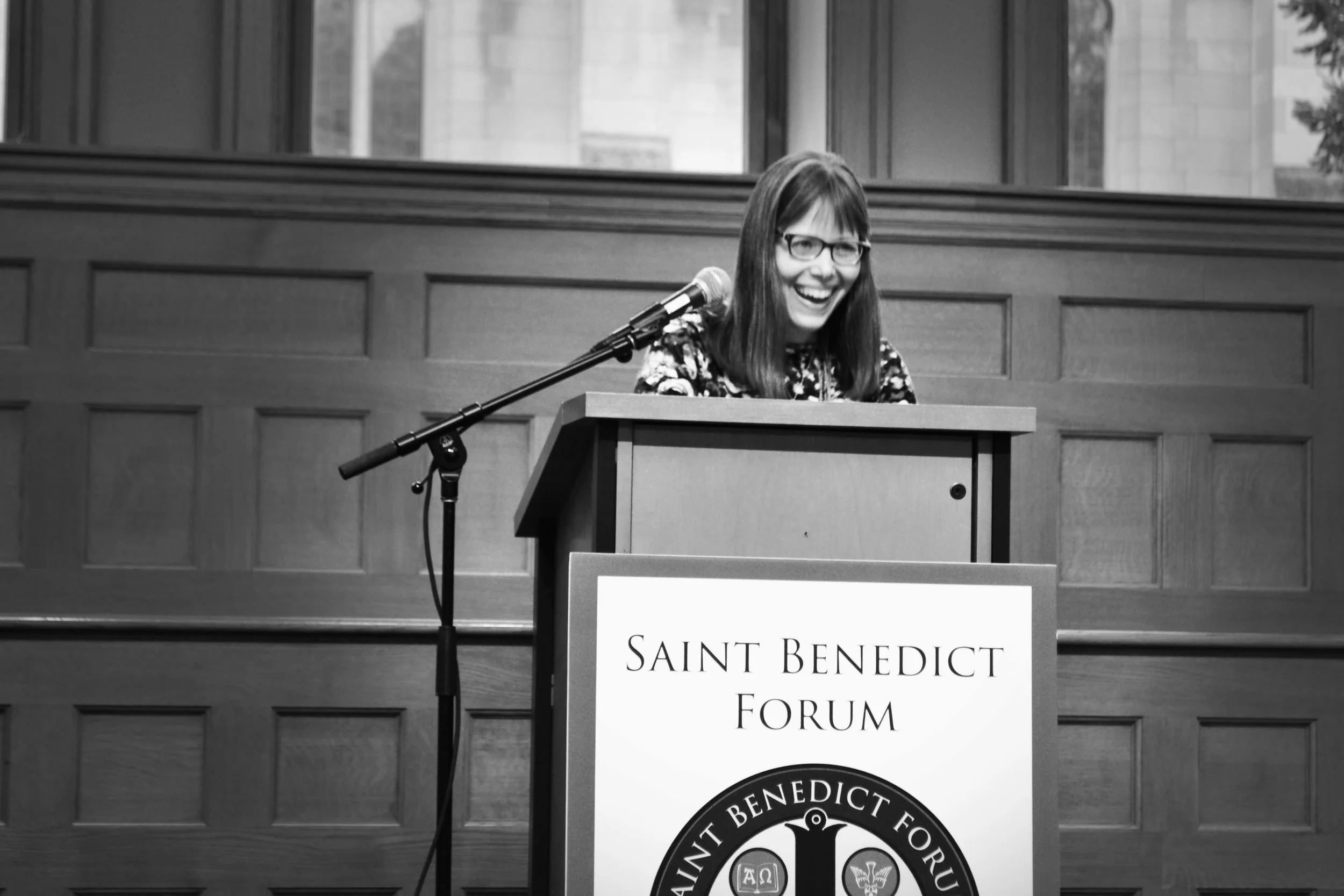
Dr. Esolen described to us the state of the students he is currently teaching. He is grateful for the bright eyed and bushy tailed freshmen who “do not yet have mildew growing on their souls,” but instead have unbounded amounts of enthusiasm. They also have a lot to learn. Many step into his Classics courses never having heard of Milton, Tennyson, or Chaucer. Upperclassmen (who are sans the enthusiasm) are also unacquainted with these literary pioneers. This is not their fault, but rather offers a critique of the present state of high school education.
The American educational system looks bleak: schools eerily resemble prisons or factories, and should it surprise us when form begins to follow function? Class work places an unhealthy emphasis on 20th century dystopian novels and has a strong aversion to anything that even faintly bears the scent of theology. Dr. Esolen holds that the attempt to excise theology and all traces of Christ from high school education has removed the true core - the heart - of education.
According to Dr. Esolen, many secular colleges and universities are no different. Secular universities have abandoned their ties to early and medieval Christian writers. They unknowingly do themselves a disservice by severing themselves from literature brimming with ideas of truth, love, and what it means to be human. Additionally, there is no multidisciplinary dialog. There is no longer a core, no center axle around which the university rotates. Instead, each school or department operates in isolation, training their students in narrow, robotic excellence. Thus, the “university ceases to be a university, but becomes a polytechnical institution,” a place starved of wonder, depth, and meaning. There is no bigger picture, nothing held in common, and nothing to unite a public save a shared zip code.
Dr. Esolen went on to say that polytechnical institutions will not continue to grow unchallenged, for students are not machines made to function in a fractured, utilitarian manner. We are humans, “with great heart.” The Christian liberal arts college, he states, recognizes this. Through a liberal arts education and an abiding devotion to theology, these colleges help students keep their sense of wonder through brushes with beauty, providing a place to practice contemplative longing. Rather than disenchantment, students and professors alike know that they are “related to one another, embarking on a pilgrimage, and bound by something that transcends all of them.” Dr. Esolen related one such brush with beauty by describing how a former student came to know Christ through exposure to great Catholic-influenced literature.
Hope students, I imagine, understand a little about this. It’s the surprising acknowledgement that you can enjoy your general education required courses more than your major courses. It’s the harmony that exists between the Sailing and Physics Clubs. It’s also the dreaded interdisciplinary studies and coffee infused conversations that all center around the question, “Why?”
I was not fooled by Dr. Esolen’s soft-spoken character and his unassuming poetical delivery; his lecture was nothing short of a valiant cry for the preservation of beauty, and a charge for both educators and students to “behold” more often. There was nothing piecemeal or utilitarian in his demeanor; his heart was indeed behind his ribs, in his legs, and in his hands. He was guided by the belief that instruction in love, by love, is an education that makes us more human. And I think he might be right.
This event was co-Sponsored by Hope College's Religion Department, the English Department, the Philosophy Department, the General Education, Senior Seminar, and Cultural Heritage Programs; Klesis, Markets & Morality, and the Our Sunday Visitor Institute.
Anthony Esolen teaches Medieval Literature and Theology, Renaissance Literature, and the Development of Western Civilization at Providence College. He is a senior editor for Touchstone: A Journal of Mere Christianity. He is author of Ten Ways to Destroy the Imagination of Your Child and, most recently, Reflections on the Christian Life. Professor Esolen has also translated Dante’s Divine Comedy.
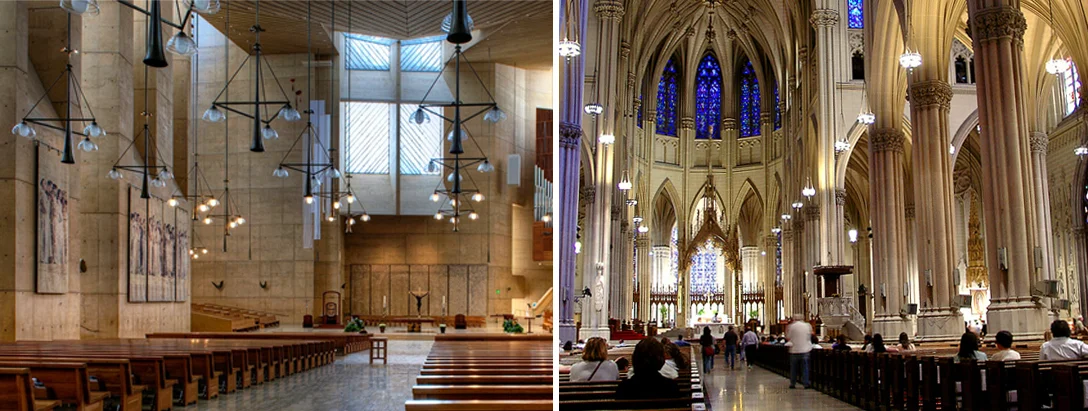
Duncan Stroik on Architecture for the Poor (VIDEO)
On October 15, 2015, Duncan Stroik gave a fascinating lecture, entitled, "Architecture for the Poor." He asked: What sort of architecture is appropriate for the poor? Should the buildings we construct for the disenfranchised express their poverty through economical materials, humble proportions, and functionalist interiors? Do beautiful, ornate churches disregard those who struggle for basic comforts? A rousing, thirty-minute Q & A session followed Stroik's talk.
The event was co-sponsored by Hope College's Religion Department, the Art and Art History Department, Sociology and Social Work Department, Markets & Morality, and the Our Sunday Visitor Institute.
Duncan G. Stroik is a practicing architect, author, and Professor of Architecture at the University of Notre Dame. His built work includes the Our Lady of the Most Holy Trinity Chapel in Santa Paula, California, the Shrine Church of Our Lady of Guadalupe in LaCrosse, Wisconsin, and the Cathedral of Saint Joseph in Sioux Falls, South Dakota. Prof. Stroik is also the author of The Church Building as a Sacred Place: Beauty, Transcendence, and the Eternal, and edits the journal Sacred Architecture.
Dawn Eden Gives Hope to the Hurting (VIDEO)
On September 16, author and popular speaker, Dawn Eden, gave two talks on the campus of Hope College: "How Jesus’ Sacred Heart Healed My Memories" and "Thrill of the Chaste: Finding Fulfillment While Keeping Your Clothes On"
By Anna Jones, Religion and Philosophy Major, Class of 2018
It was almost three o’clock, and the afternoon’s talk by speaker and author Dawn Eden was about to begin. Coffee-shop conversation bubbled around me in the Fried Hemenway Auditorium as we waited for her to start. I had heard Eden speak that morning during the Wednesday chapel service and was excited to hear more of her story. The chapel talk had given a brief introduction to the topic Eden was about to discuss at length: “How Jesus' Sacred Heart Healed My Memories.” The talk was linked to her book, My Peace I Give You: Healing Sexual Wounds with the Help of the Saints, which discusses the whole story of her trauma and healing.
Strangely enough, joy was tangible in her presence. Eden had experienced severe suffering and was now in a sense reliving that pain with all of us by retelling her story. She spoke of how she still suffers from PTSD, yet her presence was one of such peace and joy that I couldn’t help but marvel at the work God has done in her.
Raised in a semi-devout Reformed Jewish home, Eden eventually lost her faith in God, seeking love and fulfillment by living a promiscuous life as a rock-and-roll journalist. In the afternoon talk, Eden spoke of how she had blocked out many painful memories, and in so doing brought an even greater pain to herself. Through the mercy of Our Lord and devotion to His Sacred Heart, Eden found the transforming love of Jesus, which turned the suffering of her memory into a pathway that brought her into union with Himself.
That evening in Winants Auditorium, Eden gave another talk entitled, “Thrill of the Chaste: Finding Fulfillment While Keeping Your Clothes On.” This talk touched on the story found in her book of the same name. Eden gave a testimony that recalled the abuse she suffered as a child, her search for fulfillment and value, and her eventual conversion and healing in Christ. Before her conversion, the wounds Eden suffered as a child told her that her value rested not in who she was but in what she would do. She suffered from guilt, made even worse by being told that the abuse perpetrated on her was her own fault.
In spite of this, Eden related that as a child she knew the necessity of love and came to the realization that if we loved one another, there would be peace. Eden related how she pursued an ever allusive “love” by chasing relationships and pushing the physical boundaries of each one. In essence, she was attempting to prove her worth. Her lifestyle was enabled by the rock-n-roll world she chose to be a part of which asked no questions of her about moral rightness. Ironically, it was this very life of wandering that eventually brought Eden to the fulfillment and healing she longed for.
During a phone interview with a member of a popular band at the time, Eden was introduced to a book entitled, “The Man who was Thursday” by G.K. Chesterton. Her interest was piqued and she picked a copy of the book. She was struck by the book’s statement, “The most poetical thing in the world was not being sick.” This struck a chord in Eden’s heart. Eden read more work by Chesterton, which eventually led her to Chesterton’s inspiration, the Bible, particularly the Psalms and the Gospels. Scripture became real and three-dimensional for Eden, not just “flat words on a page.” Through the working of the Holy Spirit she was led become a Christian, eventually discovering the richness and truth of the Catholic Church.
Finding the teachings of the Catholic Church “profoundly liberating,” Eden began to see that Chastity is an active virtue and not a mere restriction. This new found teaching defied the accusations of her wounds and confirmed her identity as a beloved daughter of the living God. Dawn Eden’s story was truly inspiring, filled with joy and grace and the message of Jesus’s redemptive healing which is so needed in this world’s broken culture. Her testimony offers hope not only to those who have suffered as she has, but also to all those seeking a life of abundance in Christ.
Dawn Eden is the author of Thrill of the Chaste (Catholic Edition): Finding Fulfillment While Keeping Your Clothes On (Ave Maria Press, 2015, revised and updated from 2006 edition) and My Peace I Give You: Healing Sexual Wounds with the Help of the Saints (Ave Maria Press, 2012).
All photos by Joy Rhine.
Lecture on Pope Francis with Dr. Eduardo Echeverria
via Shutterstock, rights managed.
The Saint Benedict Forum was pleased to welcome our friend Dr. Eduardo Echeverria, Professor of Philosophy and Systematic Theology at Sacred Heart Major Seminary who spoke on the topic of "Pope Francis's Temptations: The Church in the Modern World" on Tuesday, September 29th, at Hope College in the Maas Conference Room (264 Columbia Ave). The event was co-sponsored by the Our Sunday Visitor Institute and the Religion Department.
The video of the talk will be available soon.
With Pope Francis's recent visit to the United States and Cuba, many have had an opportunity to learn more about this charismatic and yet humble pontiff. Nevertheless, the pope is often confusing to many groups of people. Many appreciate his concern for the environment, his clear opposition to the death penalty, and his devotion to the poor. Yet, he is also a persistent defender of the traditional family, the right to life at every stage, and religious liberty. Dr. Echeverria helped us understand what really animates Pope Francis and why he defies so many caricatures of the papacy and the Catholic Church.
Casting the Demons Out....of the Dorm Room
A blessing of dorm rooms? What’s that about...? Last year, the Saint Benedict Forum organized the first-ever blessing of dorm rooms on the campus of Hope College. The event was such a hit that it was brought back again this year. This year’s blessing of dorm rooms took place during the second week of school once students had time to settle in . . . and to give them an excuse to do some possibly needed housekeeping.

By Colin Whitehead, Religion and Spanish Major, Class of 2017
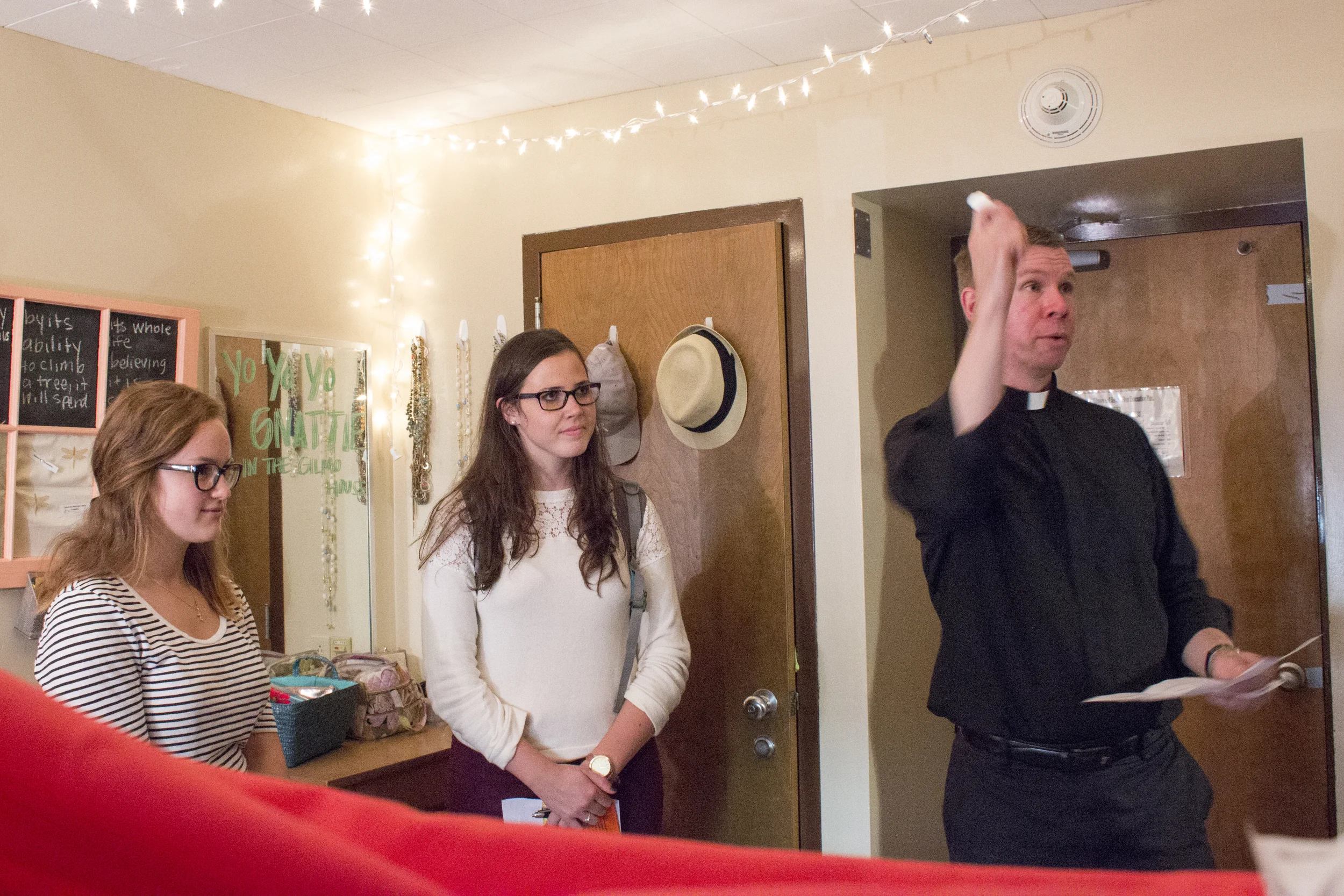
A blessing of dorm rooms? What’s that about? Well, Christians have been giving thanks and having things blessed for a long, long time. Voyages. Harvests. Marriages. Pets. Building sites, you name it. So, why not bless the place where you live, study, and relate to roommates? Last year, the Saint Benedict Forum organized the first-ever blessing of dorm rooms on the campus of Hope College. The event was such a hit that it was brought back again this year. This year’s blessing of dorm rooms took place during the second week of school once students had time to settle in . . . and to give them an excuse to do some possibly needed housekeeping.
Like last year, Fr. Charlie Brown of St. Francis de Sales Catholic Church in Holland, MI, met a group of excited students at Phelps Dining Hall to share a meal with them.
Joining him this year was a new face, Fr. Bill VanderWerff. Fr. Bill, a recently ordained priest, replaced Fr. James VanderLaan earlier this summer as Associate Pastor at St. Francis de Sales. This meal provided the Fathers a chance to catch up with some students after the long summer break as well as to form new friendships with others. Once the conversation came to an end, it was time to begin the blessings. One student led Fr. Bill to most of the dorm rooms slated for a blessing while another student guided Fr. Charlie to the remaining dorms as well as the cottages and apartments.
Credit should be given to the students, especially the freshmen, who signed up for this event. I am sure it took a good deal of courage for them. It can be unnerving to consider having your new friends see a priest standing in your room performing what looks to them to be a strange ritual. First, the priest begins in prayer. Then he reads a passage of Scripture. He douses the student, room, and roommate with holy water to recall one’s baptism. Finally, a communal Our Father is offered along with a blessing. And, there you have it—the old dorm room has passed away; behold, the new room has come. Or, something like that.
As Fr. Charlie finished blessing a dorm room, a freshman asked him to bless her room. She had seen the announcements but had not signed up. The ability to bring peace of mind to a new student who is still adjusting to Hope highlights the importance of the bridge that the Saint Benedict Forum provides between Hope students and St. Francis de Sales Catholic Church.
Several students shared with me what the room blessing meant to them. Miriam Hernandez, a senior, said, “I feel incredibly privileged to have this opportunity. This for me was yet another way that God allowed me to be in connection with Him through my daily tasks and reminded me that He never leaves my side.” When asked how the blessing will affect the work that she will do in her room, she stated, “[It] makes me feel at spiritual peace, welcomed and comfortable in my room. The blessing affects to a great extent the work that I do. It allows me to relax and focus on my school tasks as I know God is with me.”
Another senior, Ivy Keen, related that the blessing made her room feel more like home. “The sprinkling of water was a significant part of the blessing,” Ivy said. “By consecrating the rooms, it made the blessing more permanent, and this makes my room feel more permanent, like a home.” She said further, “The blessing will help to foster an environment that encourages prayer, relationships, and openness. My hope is that my room will be a place where all of these things can take place, both between me and God and among my roommates and me.”
By inviting Fr. Charlie and Fr. Bill into their rooms, students were able to interact with them in a more personal way than they are used to doing at Mass. As a new school year is underway, and prior to first exams, this could hardly have come at a better time. Thank you to Fr. Charlie, Fr. Bill, and to all who were involved.
“The Saint Benedict Forum and St. Francis de Sales Catholic Church, blessing rooms since 2014.” Now that has a ring of a nice tradition to it . . .
All photos were taken by Aaron G. Estelle.
How I Fell Away from and Reverted to My Childhood Faith (AUDIO)
On July 8, Dr. Jared Ortiz was interviewed by Gus Lloyd on his show Seize the Day. He spoke on how he fell away from Catholicism and how God drew him back through books and people. The segment was broadcast on Sirius XM Radio's channel 129, the Catholic Channel. Listen to the interview here.
Thank You Our Sunday Visitor Institute!
Last April, the Our Sunday Visitor Institute awarded the Saint Benedict Forum a matching grant. We are pleased to announce that the matching grant is complete! In three short months, we raised $22,000 and the Our Sunday Visitor Institute has matched it! We are grateful for the generous support of our work. It is a real blessing to have the encouragement of this fine Institute.
We are also grateful to all of our benefactors who made this opportunity a rousing success. You make our work possible. May God richly bless you!
In Their Own Words: Immersion Trip 2015
"Like St. Veronica, sometimes the Lord calls us to wipe the sweat from the brows of those who are suffering...."
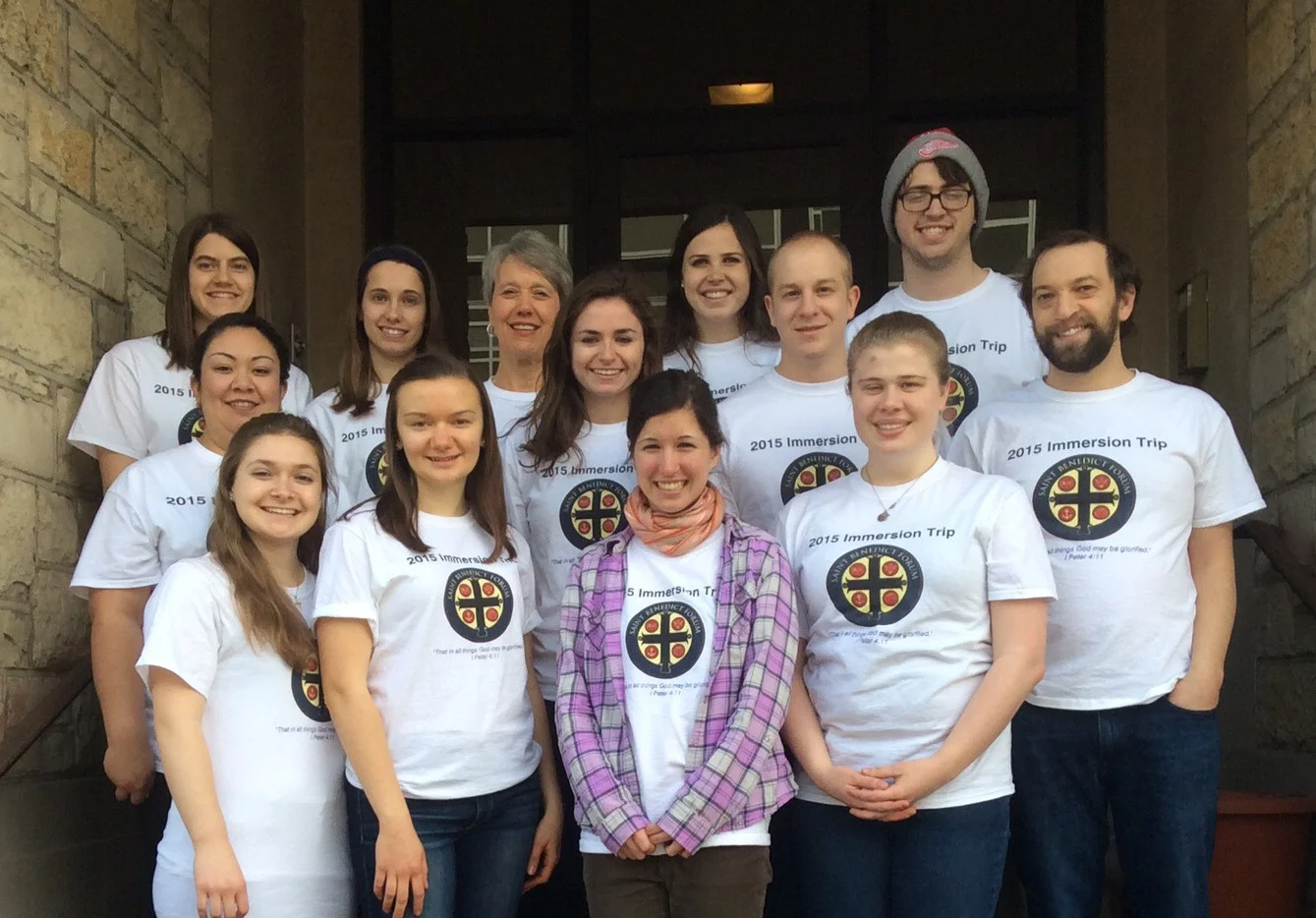
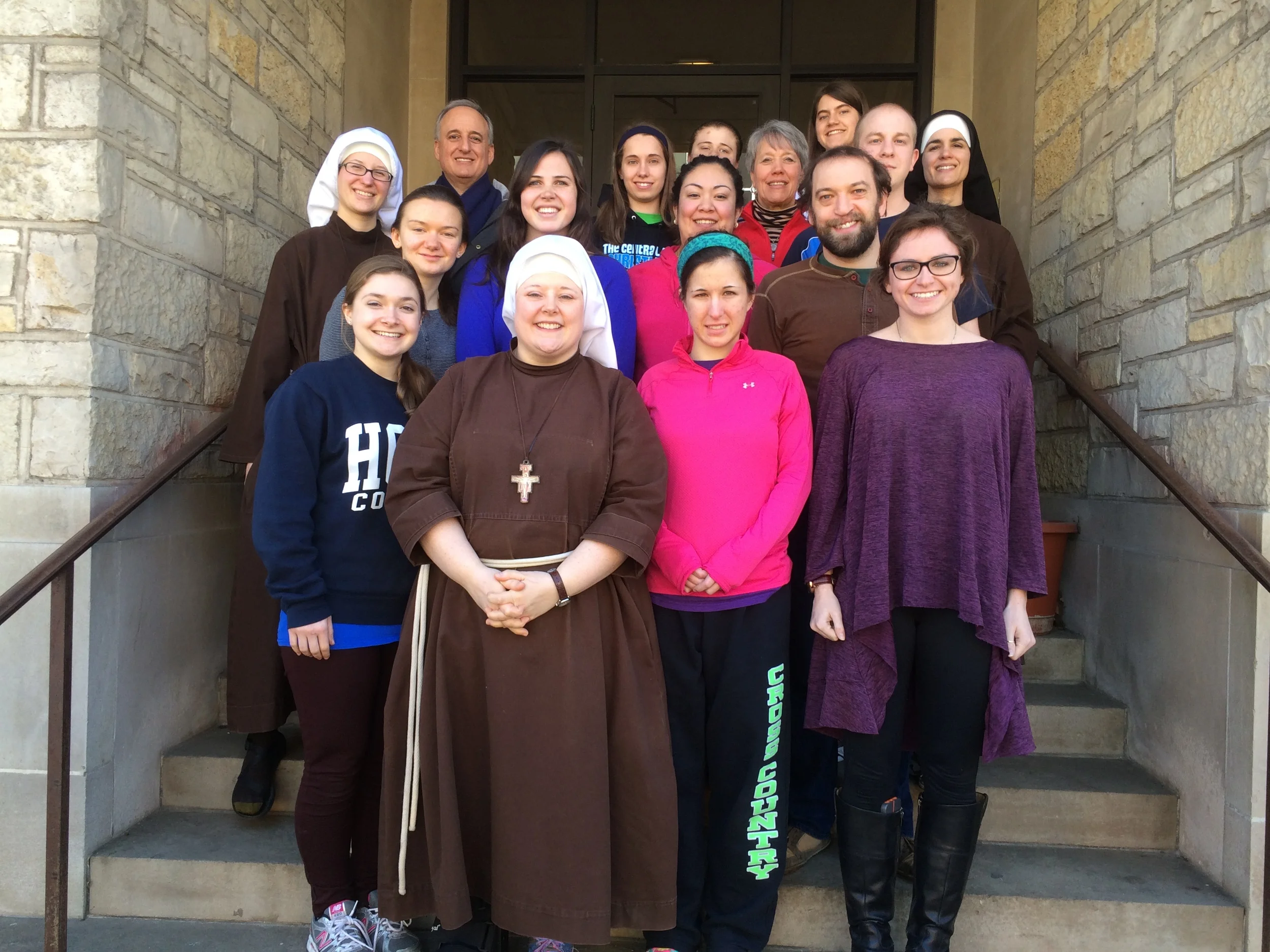
For Spring Break 2015, eleven Hope College students worked alongside, prayed with, and learned from the Franciscans of the Eucharist in Chicago's Humboldt Park neighborhood. Below are some of their beautiful reflections on the week.
The Trip in Three Words
“I've been trying to think of a "quick and easy" way to respond to your questions... But my heart is so full after the trip that I don't really know if that's possible. Well, here goes: "Taste and see." (As in, "Taste and see the goodness of the Lord." Andrew brought a few hymnals, and this was one hymn we sang that really hit home.)”
“I had such a hard time putting my growth from this trip into words. My heart is truly overflowing . . . Three words to describe the trip: discovery, perspective, inspiration.”
“Relationship-driven, reflective, peaceful (in that we were removed from the clutters and stimulation of life centered on material things while living with the nuns)”
“Awe-striking, Heartbreaking, Inspiring”
“Thought-provoking, refreshing, simple”
“Challenging, thought-provoking, stirring”
“Intense, edifying and hopeful"
“Community-based, prayerful, loving”
“Frustrating, heartbreaking, joyful”
One Memorable Highlight or Story
“Any day spent in the after school program with the little kids was awesome (I was with the 6-8 boys). Tutoring William who has autism was incredible and having Darrian try to teach me how to "slow dance" was a great slice of happiness I will carry with me.”
“The best part of the trip was seeing how the sisters interact with the community that they are now a part of. They are truly respected by the people they are helping and they are not seen as outsiders.”
“The sisters are possibly some of the greatest people I have ever met. I was blessed with opportunities to have serious one-on-one conversations with almost every one of them over the course of the week, and each time I felt completely inspired.”
“Sister Kate tried to convince us that we were having blended liver for dinner one night, but we caught her in the joke because it was a Friday in Lent, and we knew there was no way they would serve us meat.”
“It all just seemed so hopeless, like there was nothing that anyone could do. But at the same time, seeing the dedication of the people who run the afterschool program, talking to some of the kids at the high school who really do have hopes and dreams and plans for college and were so willing to work to make those real, witnessing the good work the Franciscans are doing in the neighborhood... All of that was so full of hope. It blew me away how there can be so much good and so much beauty in such a broken, difficult place.”
“My favorite moment of the trip was when one student opened up to us during the reflection shortly after he learned of his grandfather’s passing away, and how everyone rallied around him and the whole group came together to support him and each other.”
“I'd like to share two highlights, the first being Daniel's witness story, and how it so effectively touched me and made me notice what might also being missing in my faith journey as well, and then the other highlight would have to be when I talked about my father, and grandfather on the trip, which was very hard but at the same time very humbling.”
“While the entire trip was one huge highlight in itself, I especially loved how the trip helped me see past stereotypes and make connections with so many people despite vast differences. Watching the sisters’ willingness to reach out to the community, I was inspired to abandon my own preconceptions or criticisms and open my heart to discover the power of sharing Christ’s love through service. It was extremely uncomfortable at first, but it allowed me to discover the freedom that lies in selflessly giving to others in big and small ways. I built such powerful relationships through service with the community, with the nuns, and with my peers.
I also was able to discover the value that lies in a life of simplicity, humility, quiet, and all-encompassing service. The sisters have created such a calming, faith-focused environment despite the chaos and despair in the neighborhood. It is truly a little piece of heaven.”
“Near the end of the trip, Sister Stephanie told our group that their boiler had just broken. So the sisters were without heat in their home. Sister Stephanie seemed surprised but not worried. Her attitude wasn't "We don't have the means for this. What is God thinking?" but rather, "Well, that happened. Here's another chance to lean on God." It was at this moment that I realized just how much the sisters place their trust in God. The sisters had said multiple times before how everything they have is donated, but it didn't really sink in until Sister Stephanie told us about their boiler. This realization of how much God will provide if we let Him, and of how much He wants to provide, has helped me tremendously in trying to say "Jesus, I trust in You" for all aspects of my life.”
The Impact of the Trip in One Sentence
“After this trip life does not make any sense without God.”
“This trip taught me that God’s mercy is present even in the darkest, most seemingly hopeless of situations.”
“This trip not only helped become conscious of where joyful self-giving and reckless abandonment to God are called for in my life, but also intensified my appreciation for genuine friendship and community that is rooted in Jesus Christ and His Church.”
“This trip gave me some hope for the world by showing me some of the unseen work being done to help those living in poverty and violence both spiritually and physically.”
“A relationship with God is necessary for complete fulfillment and joy.”
“This trip challenged me to re-examine a faith I had grown all too familiar with, helping me rediscover my appreciation for Catholicism and the way it is being lived out in humble service today.”
“In one sentence, man this will be fun... Ok so here it is: My spiritual life was in a way shattered, and the trip led me to re-evaluate what my journey has been, and try to piece together what my life means.”
“Staying with the Franciscans really made me realize how important it is to rely on God's provision, in terms of material things, of course, but also in terms of spiritual and emotional stability. I don't think the sisters could do what they do where they do it without relying on Him for sustenance through prayer, through His Word, and through His body and blood. We had a difficult enough time, and we were only there for a week.”
“Much of this week was challenging to witness, even in the context of all the amazing work that the sisters are doing in the neighborhood. At several points during the week I found myself very discouraged in regard to God's plan for His people in the area as well as in regard to my helplessness. In a time of reflective prayer and reading, it was brought to my attention that like St. Veronica, sometimes the Lord calls us to wipe the sweat from the brows of those who are suffering. It was a beautiful revelation for me, and probably the main message that I'm taking out of the immersion trip. I felt blessed by the compassion that I felt for the people that I met and stirred by the freedom I found in the calling to suffer with others. I tend to want to fix all the problems in the world, and this week really showed me that it is not my will to change the world that I must chase but rather the will of my Heavenly Father, who is often simply calling me to love others and walk with them through their journey instead of try to fix them.”
Immersion Trip 2015: Franciscans of the Eucharist
By Daniel Karlovich, Hope College '15, Engineering Major
During Spring Break this year I was blessed to go on the Hope College Immersion trip sponsored by the Saint Benedict Forum to Chicago. With 10 other Hope students and two adult mentors from St. Francis de Sales Parish in Holland, Michigan I lived and worked at the Mission of Our Lady of the Angels alongside members of the religious order Franciscans of the Eucharist of Chicago. It was a powerful and blessed experience for us all.
During the course of the week we learned to live simply like the Franciscans. A significant part of the trip was spent doing simple tasks such as cooking and cleaning. We quickly learned from the sisters that even such “boring” chores take on great meaning when done with joy and love for Christ.
We also ventured into the community in which we were living. Inside one of the poorest and most violent neighborhoods in Chicago, we spent a few hours every day at the local YMCA with the children in their after school programs. Helping teach a junior class at the local high school, a school with a 67% dropout rate, was particularly powerful for many of us. We also visited a Catholic school, Cristo Rey, and learned about all the wonderful work they are doing to help underprivileged children get a good high school and college education.
All these great things were secondary to what the trip was mainly about. The trip was about self-reflection, learning what it means to live as a Christian in a broken world. It was here that the trip made a lasting impression on me.
I don’t think this trip was easy for anyone. We all were blessed by our experiences, but it wasn’t comfortable. It was a week of both great joy and great sorrow. Joy seemed to just flow from the sisters and it influenced our whole week in our work and in our relationships with each other and the people we met. What a contrast to the pervasive sorrow caused by the poverty and violence that was so prevalent and normal in the neighborhood and in the lives of those we met. Living for a week in an area of so much violence and poverty made all of us ask questions of ourselves and of God that we perhaps had never asked before.
What were these questions? We questioned what purpose was there to come into these people’s lives for a week and then leave. How could we change anything in so short a time against such overwhelming odds? We also questioned ourselves, where are we in our own spiritual journeys? Where is God in our lives?
Some of these questions are easy to answer. Immersion trips are aptly named because we really do not go to help others. We cannot change anything in a week. We go to learn about ourselves and to deepen our own understanding and love of God. In this aspect, this trip succeeded. Some of us left hopeful despite all the struggles. Others left frustrated. It wasn’t the frustration that comes from failure, but the frustration of struggling with a hard question that taxes us spiritually and mentally, but which always leaves us better for the struggle.
For me, being in the midst of so much violence and poverty left me feeling more hopeful than I have in a while. Despite the conditions of the neighborhood, I found so much good there. All the residents we met were loving and welcoming. The kids were a constant joy to be around. The YMCA employees worked tirelessly to get the kids off the streets, to do their homework and have a hot meal. And, of course, there are the sisters who are respected and loved within the community, doing everything with so much abundant joy and love for God. I realized that despite the evil in the world there are so many people who go about their lives humbly and lovingly in the midst of suffering, helping those in poverty both spiritually and physically.
It is always good when facing hard questions to draw on the wisdom of other godly people. In the car ride home one of the girls, like the rest of us still struggling to come to terms with all we had experienced, read a reflection on St. Veronica. The message was clear, “sometimes all we can do is wipe the sweat from someone’s brow as they suffer” (Kerry Weber, Mercy in the City).
Before the trip we may have said we went to help the poor, but we are wiser now. Like St. Veronica, the best we could do was to wipe the sweat from those in pain as an act of love. The real change came in our own hearts.
Deification Day of Study
On March 7, the Saint Benedict Forum, Western Theological Seminary, and Hope College hosted a Day of Study on the theme, "Foundational Issues in the Western Understanding of Deification."
On Saturday, March 7th, the Saint Benedict Forum, Western Theological Seminary, and Hope College hosted a Day of Study on the theme, "Fundamental Issues in the Western Understanding of Deification."The overall goal of the Day of Study is to provide a leisurely opportunity for scholars in the region to explore together questions of theological and cultural import.
There were four informal papers:
Carl Mosser (Notre Dame) - “How Deification was Mislabeled as ‘Eastern’: Ritschl, Harnack, and the Russian Diaspora”
Jared Ortiz (Hope College) - “Deification in the Early Latin Liturgy”
Daniel Keating (Sacred Heart Seminary) - “Typologies of Deification”
Kirsten Laurel Guidero (Marquette University) - "A Pneumatic Deification? Resources and Trajectories from the Traditions on Theosis."
A dozen interlocutors from the region were invited to engage each paper in an extended period of discussion. The discussions were thoroughly enjoyable and spilled over into the breaks and lunch and after the event.
Here are a few more pictures from this delightful day: